MITRE ATT&CK mapping: alerts that speak adversary
An unmapped alert is a puzzle: something happened on an endpoint, and someone now has to figure out what it means, how bad it is, and what usually comes next. MITRE ATT&CK mapping removes the puzzle. Monitic maps security alerts to ATT&CK techniques — the industry's shared catalog of adversary behavior — so every finding arrives pre-classified: this is credential access, this is persistence, this is lateral movement. Your team responds to a named technique with known context instead of reverse-engineering raw events, and they do it on the platform that can also execute the response.
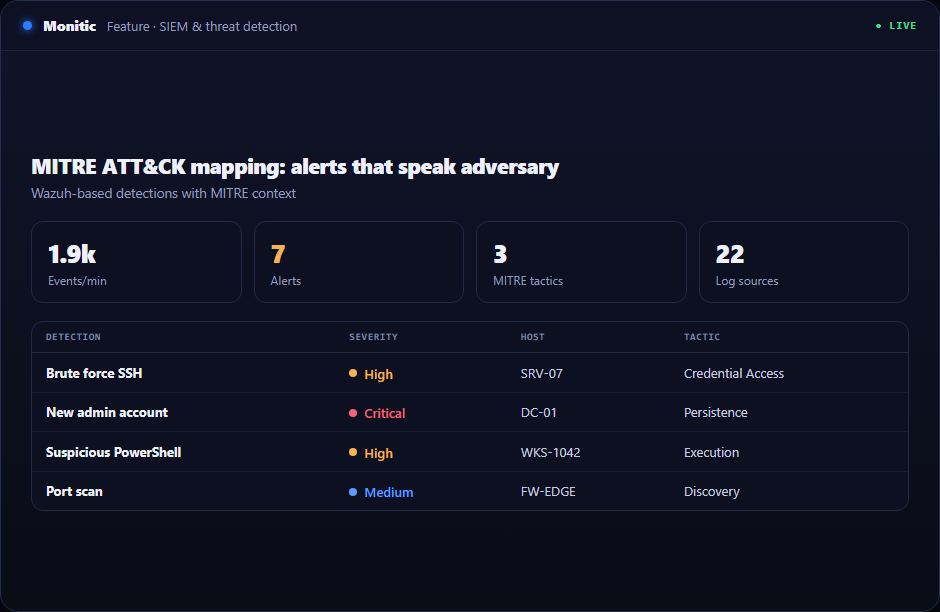
From raw event to named technique
Endpoint logs and events collected by the Monitic agent flow into Wazuh-integrated security analytics, where detections are matched against ATT&CK techniques. The mapping travels with the finding into the console: instead of "suspicious registry modification," the analyst sees the technique classification, which immediately answers the questions that otherwise consume the first hour of triage — what is the adversary trying to achieve, and where in the attack lifecycle does this sit.
For a lean IT team without a dedicated threat-intel function, this is the difference between having a framework and having a framework applied. ATT&CK's collective knowledge about adversary tradecraft is baked into every alert, not sitting in a PDF nobody has time to cross-reference.
A shared language for triage and reporting
ATT&CK mapping pays off twice. In triage, techniques let you rank by behavior: a technique associated with active hands-on-keyboard intrusion outranks a commodity noise pattern, whatever the raw severity score says. In reporting, techniques give the CISO and the board a defensible vocabulary — "we detected and closed credential-access activity on three endpoints" is a statement an auditor, an insurer, and a security committee all understand, because it is grounded in the framework they already use.
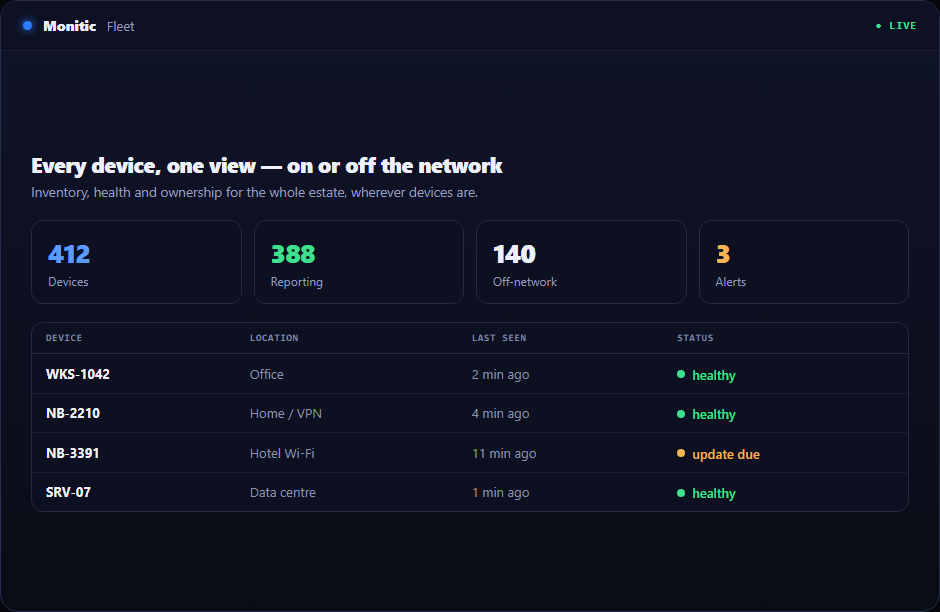
Mapped alerts aggregate in the SOC dashboard alongside posture and vulnerability data, so the technique-level view rolls up into the fleet-level one.
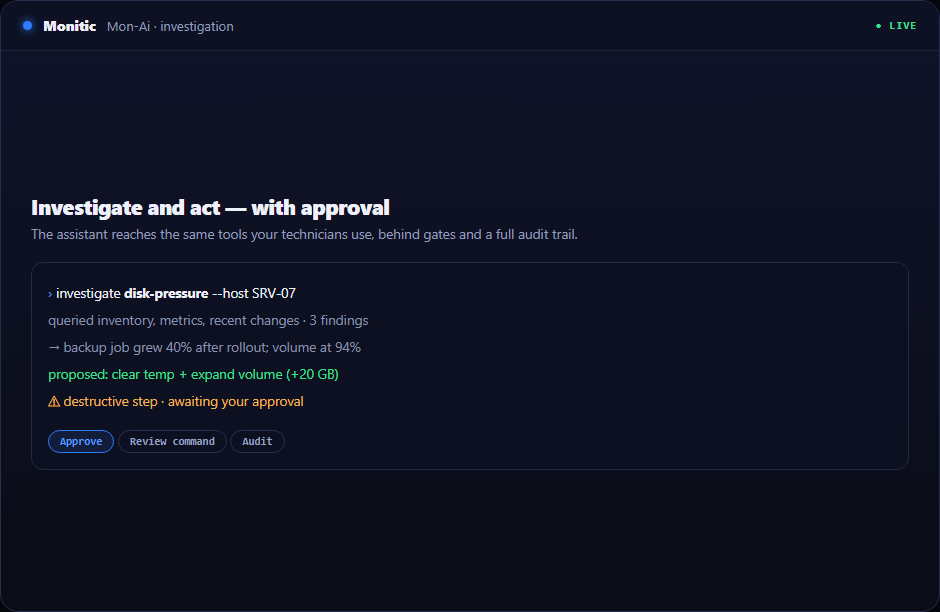
Classification that ends in action
Knowing the technique is only useful if you can counter it, and this is where Monitic separates from detection-only tools: the mapped finding sits in the same console that manages the endpoint. A technique that exploits a missing patch routes to patch deployment. One that abuses a weak configuration routes to a script or hardening change. Ambiguous cases hand off to the AI assistant with the finding, the technique, and the device context already attached. Detection names the behavior; the platform ends it.
Raw events remain in the security backend for deep investigation; the console carries the curated, technique-labeled findings your team actually works.
Works with
- Log collection — the endpoint telemetry that detections are built from
- File integrity monitoring — integrity changes classified as adversary techniques
- SOC dashboard — technique-mapped alerts in the fleet-wide view
- Vulnerability management — close the CVEs that mapped techniques exploit
Frequently asked questions
What is MITRE ATT&CK mapping?
MITRE ATT&CK is a public knowledge base of adversary tactics and techniques observed in real intrusions. Mapping means each Monitic security alert is classified against that catalog, so a finding arrives labeled with the adversary behavior it represents.
Why does technique mapping matter for a small team?
It compresses triage. A named technique carries built-in context — intent, typical progression, severity — that would otherwise require a threat-intel background to reconstruct. Lean teams get framework-grade classification without staffing for it.
Can I act on a mapped alert directly?
Yes. Findings route to remediation on the same platform: patch deployment, script execution on the endpoint, or an AI-assisted fix with full context. No export to a separate response tool.
Which plan includes ATT&CK mapping?
ATT&CK mapping ships with SIEM & threat detection in the Enterprise tier — see pricing.
See Monitic on your own fleet
Full-featured 14-day trial · no credit card · your real fleet in the console on day one.