File integrity monitoring that ends in a fix
Most compromises leave fingerprints in the file system before they show up anywhere else: a modified binary, a new startup entry, a registry key that wasn't there yesterday. File integrity monitoring exists to catch those fingerprints — but as a standalone deployment it is one more agent to roll out and one more alert stream to triage in isolation. Monitic runs FIM through the Wazuh-integrated security analytics already fed by the platform agent: changes to critical files and registry entries raise alerts in the same console that manages the machine, with a remediation path attached.
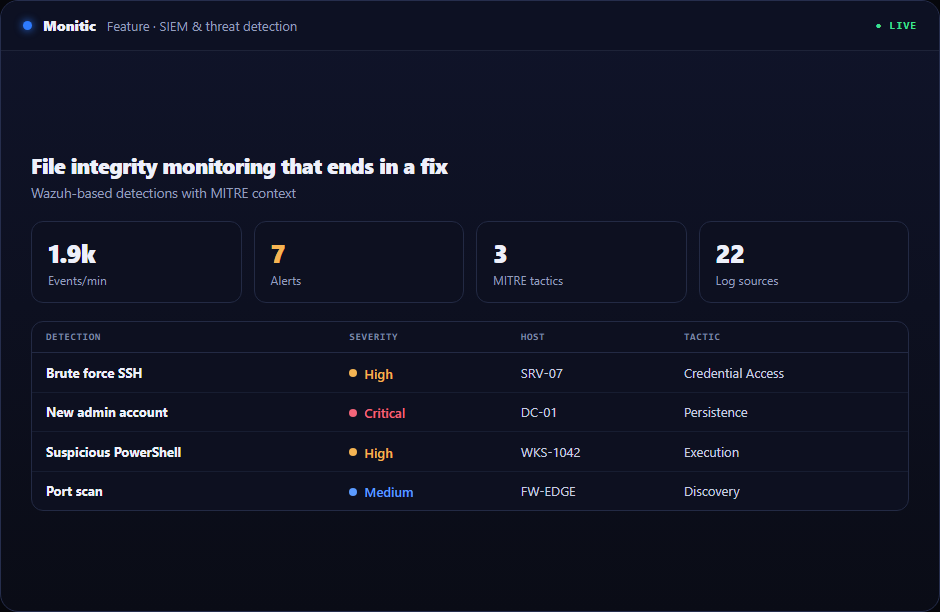
Alerts on critical file and registry changes
The agent watches the files and registry locations that matter — system binaries, configuration files, persistence points — and raises an alert when one changes. Each alert names the endpoint, the object that changed, and when. Because the alert arrives inside the management platform, the machine's identity is never a lookup: its hardware, installed software, patch state, and owner are one click away, which is the context that separates "a file changed" from "this file should not have changed on this machine."
Both malicious tampering and well-intentioned drift surface the same way. The registry edit a technician made outside change control and the persistence key planted by malware are, to the file system, the same class of event — and both are worth knowing about.
Integrity plus configuration: FIM and SCA together
FIM answers "what changed"; security configuration assessment (SCA) answers "was it weak to begin with." Monitic runs both from the same telemetry. An endpoint whose configuration assessment shows hardening gaps and whose critical files are changing is a different priority than either signal alone — and seeing them side by side is how a lean team triages like a mature SOC. Alerts that correspond to known adversary behavior carry their MITRE ATT&CK technique, so an integrity change reads as a stage in an attack rather than an isolated event.
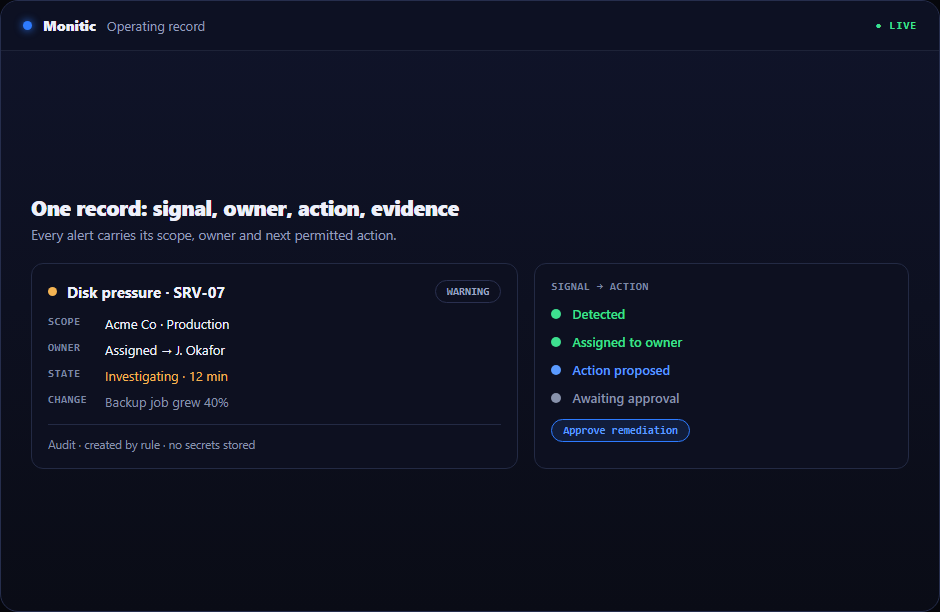
From changed file to closed finding
This is where platform FIM diverges from standalone FIM. A change alert in a dedicated tool ends in an email; a change alert in Monitic ends in an action. Route the finding to remediation on the same platform — dispatch a script to inspect or restore the endpoint, push the patch that closes the exploited gap, or hand the case to the AI assistant with the alert's full context. The finding also rolls into the SOC dashboard, so integrity events contribute to the fleet-wide posture picture rather than living in a silo.
Raw events stay in the security backend for investigation depth; the console shows the curated finding and the response options. Detection you can act on, priced as part of the platform rather than as a second security product.
Works with
- Log collection — the endpoint telemetry stream FIM findings emerge from
- MITRE ATT&CK mapping — integrity changes classified by adversary technique
- SOC dashboard — FIM findings in the fleet-wide posture view
- Security compliance — enforce the baseline configuration that FIM verifies stays intact
Frequently asked questions
What does Monitic's FIM watch?
Critical files and registry entries — the system objects whose unexpected change most often signals tampering or unauthorized drift. Alerts identify the endpoint, the changed object, and the time of change.
Does FIM require a separate agent or tool?
No. FIM runs through the Monitic agent already managing the endpoint, with analysis in the Wazuh-integrated security backend. Deploying management is deploying integrity monitoring.
How is this different from antivirus?
Antivirus judges files against known-bad signatures and behavior. FIM watches known-important objects for any change, malicious or not — catching tampering, unauthorized edits, and drift that signature engines have no opinion on. They are complementary layers.
Can a FIM alert trigger a response?
Yes. Findings route to remediation on the same platform — a script on the endpoint, a patch deployment, or an AI-assisted fix with full context. FIM ships with SIEM & threat detection in the Enterprise tier; see pricing.
See Monitic on your own fleet
Full-featured 14-day trial · no credit card · your real fleet in the console on day one.