Give every operator an evidence-first AI coworker
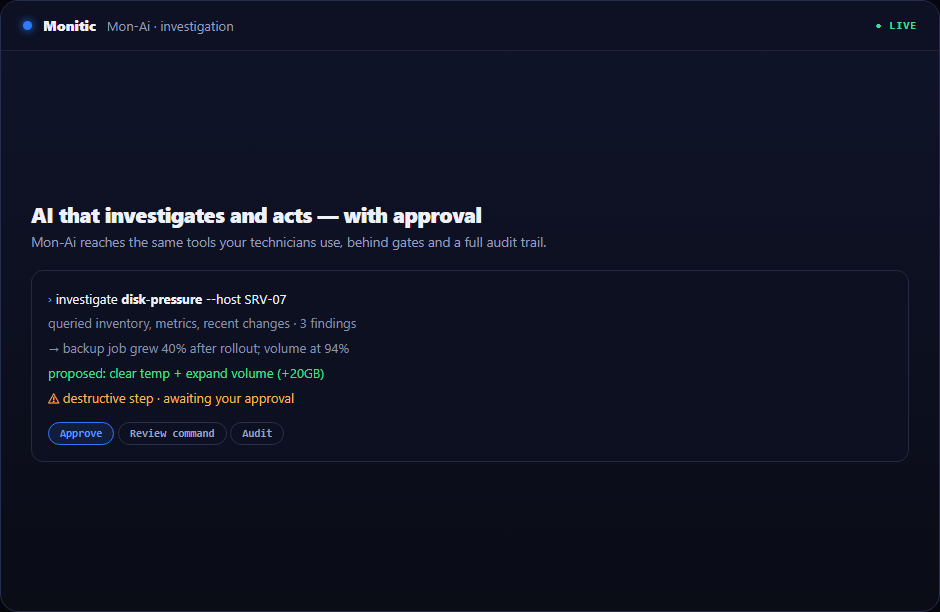
IT teams do not need another chatbot that summarizes an alert. They need an assistant that can inspect the live estate, correlate signals, propose a safe action, wait for approval, and explain the outcome.
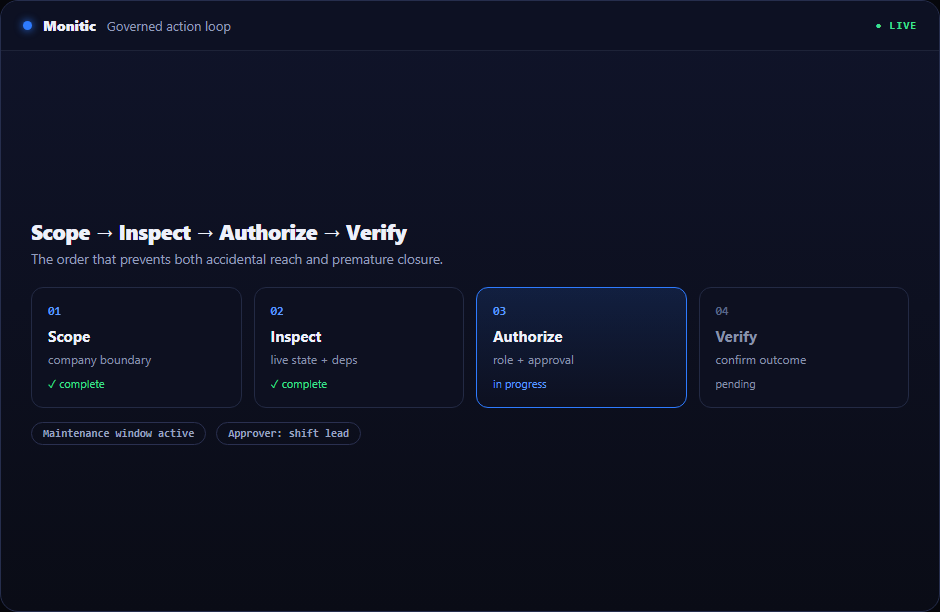
The technical action is only one part of ai for it operations. Teams must also identify the correct company, confirm ownership, work inside a maintenance context, and prove the result. Monitic keeps those decisions in a single governed path.
Why this workflow matters
Leadership sees delay; technicians feel context switching. Both come from the same architecture: separate tools maintain separate versions of the estate. Connecting ai for it operations to the shared asset and service record removes that reconciliation step.
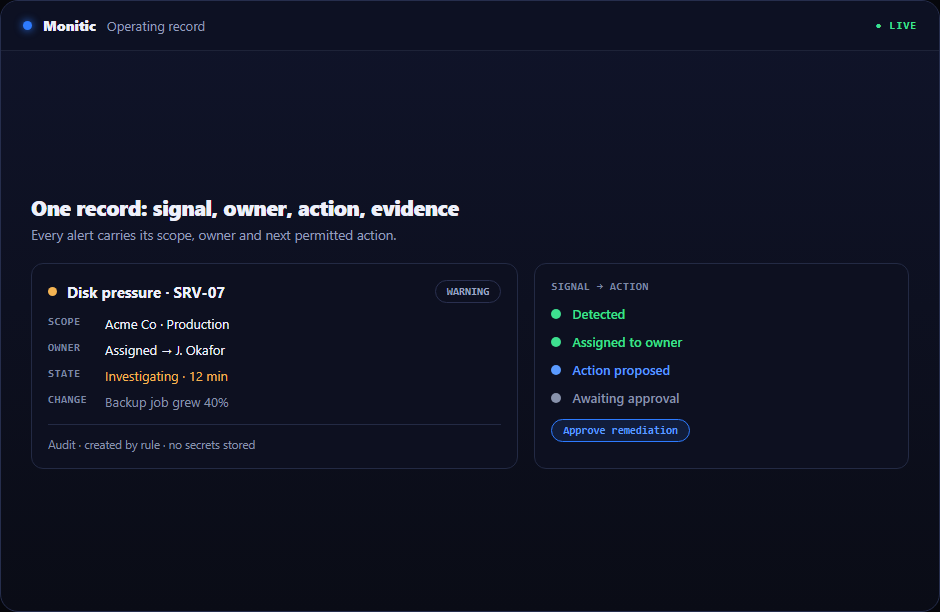
Monitic resolves the company boundary before exposing the resource, then evaluates the operator's focused permissions. AI for IT Operations can therefore be delegated without handing out unrestricted platform or vendor administration. The same identity follows the action into audit and reporting.
What ai for it operations looks like in Monitic
Gather context across endpoints, tickets, security, networks, and dependencies. Current data is paired with the resource and company behind it; the screen is designed to answer the next operational question rather than merely prove that data was collected.
Use propose-approve-execute guardrails for operational actions. A technician can move from observation to the relevant remote tool, workflow, or investigation without re-entering the customer and asset relationship.
Retain dual human and AI attribution in the audit trail. Human-run, automated, and AI-directed paths converge on the same authorization and evidence model, avoiding a privileged side door for convenience.
Evaluation checkpoints for ai for it operations
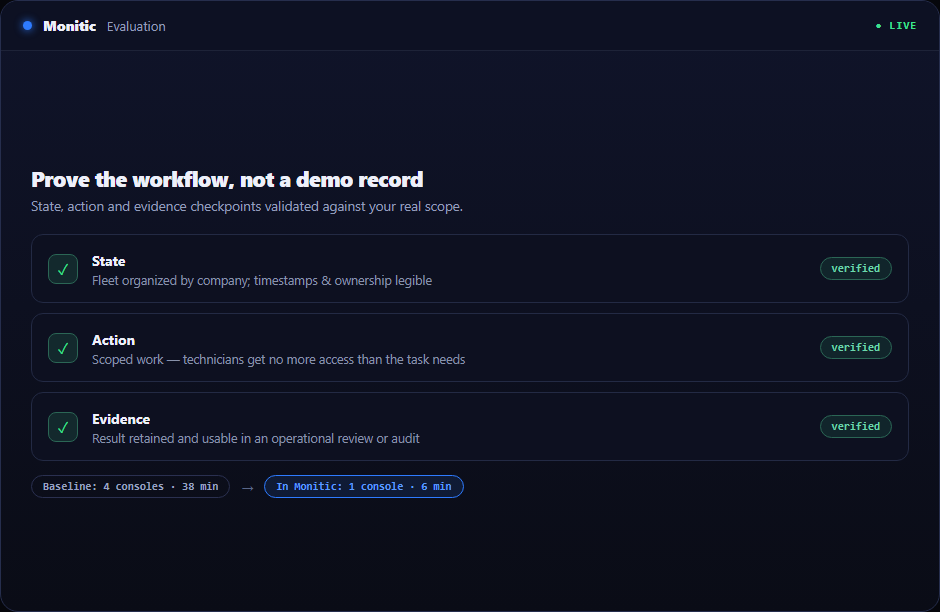
A useful evaluation should prove the workflow against real scope rather than a polished demo record. Use the following checkpoints when validating AI IT operations:
- State: Verify that the platform can gather context across endpoints, tickets, security, networks, and dependencies and that timestamps, company ownership, and exceptions are understandable to an operator who did not configure the feature.
- Action: Confirm that authorized technicians can use propose-approve-execute guardrails for operational actions without receiving broader access than the task requires.
- Evidence: Check that Monitic can retain dual human and AI attribution in the audit trail and that the result is useful in an operational review, customer conversation, or audit.
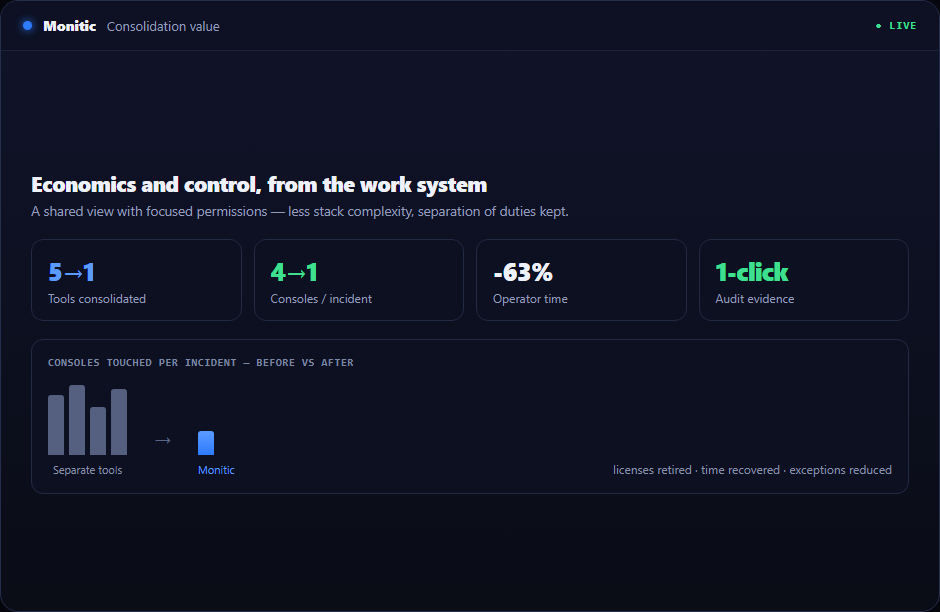
Record the baseline time, number of consoles touched, and evidence available before Monitic. Repeat the same scenario in the trial. The comparison should show whether ai for it operations reduces handoffs as well as completing the technical task.
From evidence to verified action
- Observe the exception. Separate material conditions from normal variation.
- Attach ownership. Identify the team, technician, or workflow responsible.
- Act with context. Use current evidence and the least disruptive response.
- Make closure durable. Record result, remaining exception, and next review date where needed.
The workflow scales because knowledge becomes evidence rather than folklore.
Business value beyond the feature
The practical return is operating consistency. A new technician follows the same governed path as an expert; a new customer company inherits the same isolation and reporting model; a new module reuses the established asset and identity foundations.
That consistency is what allows ai for it operations to scale without a matching increase in manual coordination.
Connected to the rest of the platform
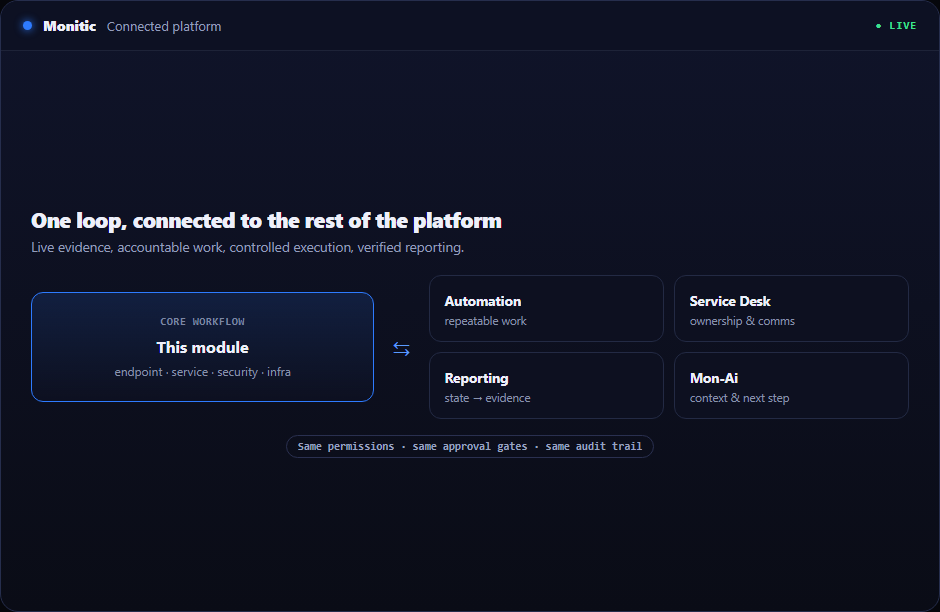
The AI for IT Operations workflow does not end on this page. Service desk can hold ownership, automation can standardize repeatable steps, and reporting can turn current state into recurring evidence. Mon-Ai uses the same scoped context when proposing a next action.
Frequently asked questions
How does ai for it operations stay inside the correct customer boundary?
Monitic resolves tenant ownership and company access before returning the resource. Role permissions then determine which operations are available inside that approved scope.
Can read access and change access be separated?
Yes. Teams can delegate visibility more broadly while reserving mutating actions for focused roles, approval paths, or designated operators.
What evidence remains after work is completed?
The platform retains actor, target, time, and outcome context for sensitive or mutating actions. AI-assisted work can also identify the directing person and AI account.
How should we evaluate AI IT operations?
Choose a representative workflow, define the expected state and evidence, then test it during the 14-day full-platform trial. Review pricing when the operational fit is proven.
See Monitic on your own fleet
Full-featured 14-day trial · no credit card · your real fleet in the console on day one.