Six tools' work. One platform's price.
Every CIO knows the drawer: an RMM here, a service desk there, a patch tool, a scanner, a vault, a remote-access product — each bought for a good reason, each still billing, none of them truly talking to the others. Tool sprawl isn't a procurement embarrassment; it's an operating tax paid three ways: in subscriptions, in the integration glue between them, and in the minutes your team loses switching contexts on every single incident.
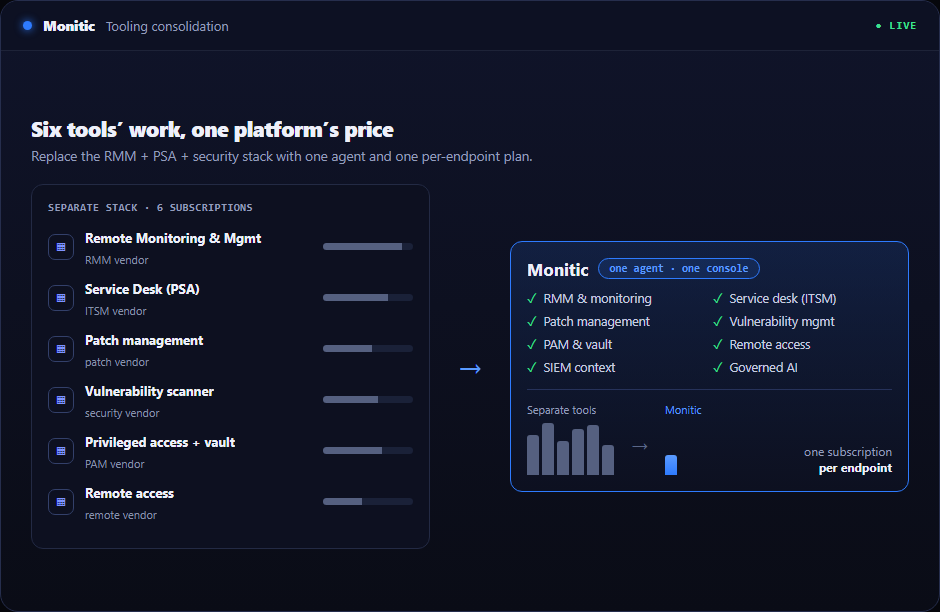
The three costs of sprawl
The visible cost. Bought separately, the standard stack — RMM priced per endpoint, service desk priced per agent, patching, vulnerability scanning, PAM, remote access — stacks up as several separate per-endpoint and per-seat subscriptions, each with its own invoice. Renewal season means six negotiations and six auto-uplift clauses.
The glue cost. Every pair of tools needs a sync: assets from RMM to desk, vulnerabilities from scanner to ticketing, credentials from vault to remote tool. Each sync is middleware to license, configure, and repair — and each is a place where data silently diverges until an audit finds it.
The attention cost. A technician resolving one incident touches three consoles and three logins. Multiply by every ticket, every day. This is the cost that never appears on an invoice and always appears in your mean-time-to-resolution.
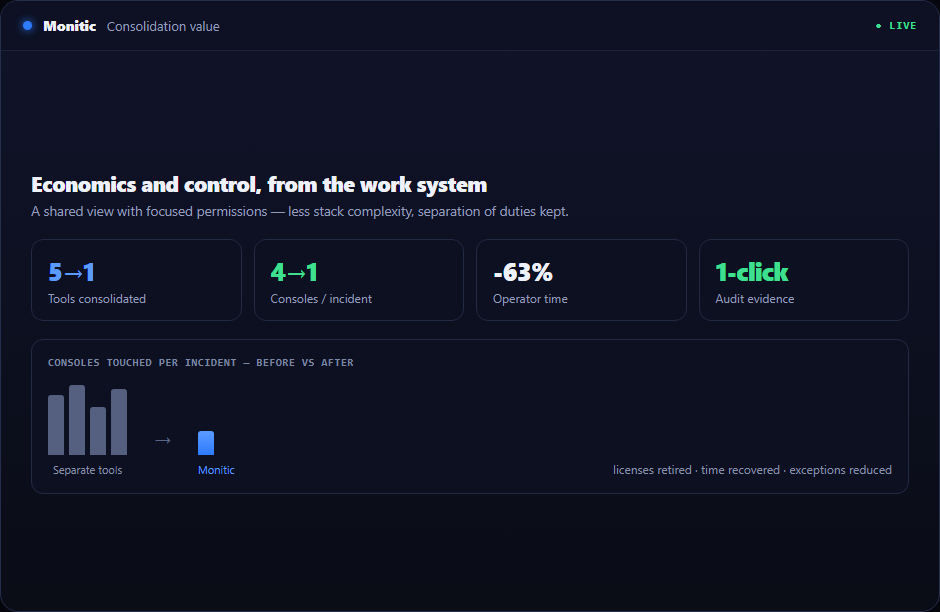
What consolidation looks like on Monitic
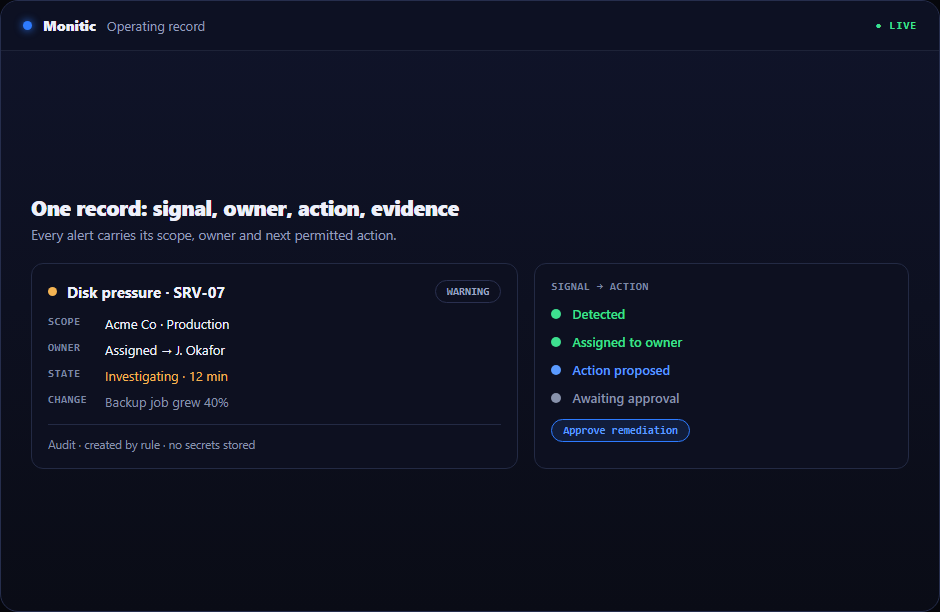
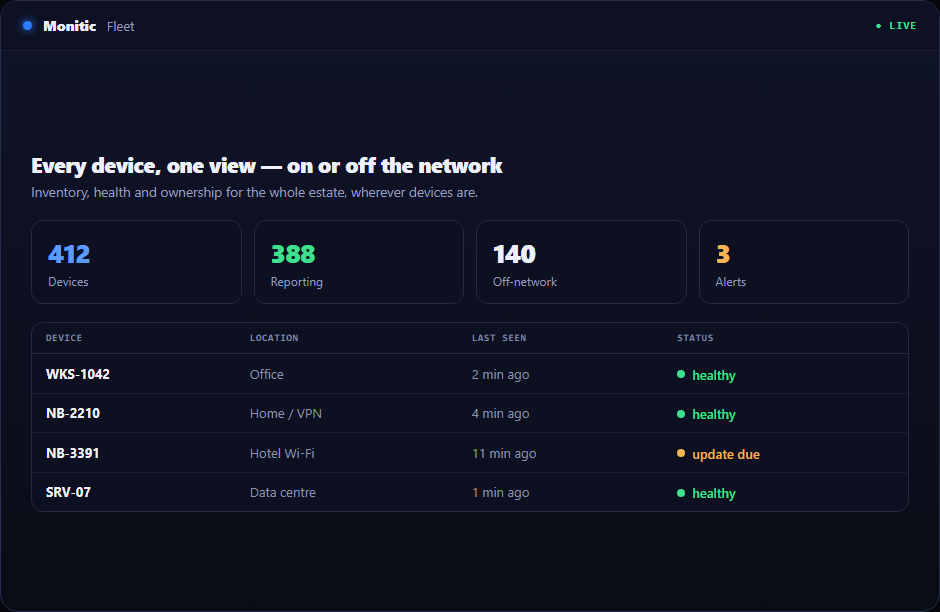
One agent replaces three (monitoring, patching, remote access are one binary). One data model replaces the middleware: the service desk reads the same records the fleet writes, CVE detection matches against the software inventory that already exists, and compliance remediates through the same automation engine that runs your scripts. One subscription replaces six — with per-endpoint plans across Core, Pro, and Enterprise. See pricing →
The migration sequence that de-risks it
Consolidation fails when it's attempted as a big bang. The sequence that works is waves, in parallel with your existing stack:
- Fleet first (weeks 1–2). Deploy the agent alongside incumbents; let inventory, monitoring, and remote access prove themselves on live operations. Retire the remote-access license first — it's the easiest win.
- Policies second (weeks 2–4). Move patching and alerting policies; run both patch engines against separate rings until confidence is earned. Retire the RMM.
- Desk third (weeks 4–8). Redirect email-to-ticket, rebuild SLA and automation rules once, migrate open tickets. Retire the desk and its per-agent pricing.
- Security last (weeks 6–10). Turn on compliance posture, CVE matching, and — where needed — SIEM and PAM. Retire the scanner and vault subscriptions.
Every wave has a rollback: the old tool stays licensed until its replacement has run your real workload.
What the board hears
Consolidation is one of the few IT initiatives that reads as both cost reduction and risk reduction: fewer vendors in the supply-chain review, one audit trail instead of six, one identity boundary, and a security surface (vulnerabilities → patches → evidence) that closes its own loop. The subscription savings fund the project several times over in year one.
Frequently asked questions
How long does full consolidation take?
Typical mid-market estates complete the four waves in six to ten weeks, with each wave individually reversible.
Do we lose best-of-breed depth?
On the RMM/patch/desk surface, Monitic goes feature-for-feature with the incumbents (see the comparisons). Where you have a genuinely specialized tool, Monitic's integrations and webhooks let it coexist.
What about our historical ticket data?
Open tickets migrate during the desk wave; historical archives can be retained read-only in the legacy system or imported — scoped during onboarding.
How do we build the internal business case?
Send us your current tooling invoices and endpoint count; we return a line-by-line comparison within one business day.
Start with the math. Start your free 14-day trial or get a demo and bring your invoice.
See Monitic on your own fleet
Full-featured 14-day trial · no credit card · your real fleet in the console on day one.