IT alerting software that pages people only when it's real
Alert fatigue is not a tooling annoyance — it is an operational risk. When engineers get paged for spikes that resolve themselves, they stop trusting the pager, and the one alert that matters gets triaged like the hundred that didn't. Monitic's alerting engine was designed around a single principle: an alert should mean a human genuinely needs to know. Everything else should be filtered out or, better, fixed automatically.
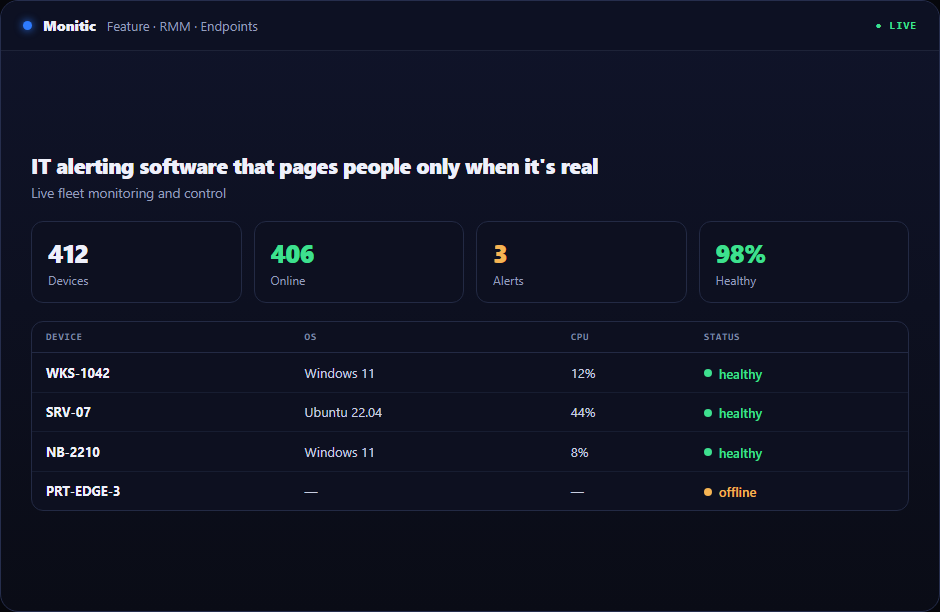
Duration-based hysteresis: the end of alert flapping
Most IT alerting software fires the instant a metric crosses a line — CPU touches 90% for two seconds during a backup job and someone is paged at 3 a.m. Monitic requires the condition to hold. A threshold must stay breached for a duration you define before the alert fires, and the metric must stay recovered before it clears. That two-sided discipline eliminates flapping: no rapid-fire open-close-open storms, no pages for transient spikes, no noise from scheduled scans or nightly batch jobs. When Monitic alerts, the condition is real, persistent, and worth attention.
For a CIO, the outcome is simple: fewer false pages means faster response to true incidents, healthier on-call rotations, and an alerting channel your team actually trusts.
Thresholds on the signals that matter
Alert rules cover the metrics behind most endpoint incidents:
- CPU, memory, disk, and temperature, each with configurable high and low thresholds
- Duration windows tuned per rule, so a database server and a meeting-room PC don't share the same tolerance
- Alerts surfacing in live dashboards over WebSocket the moment they fire — the console and the pager agree in real time
Because rules ride on the same telemetry as device monitoring, there is no separate collector to deploy and no second data pipeline to reconcile.
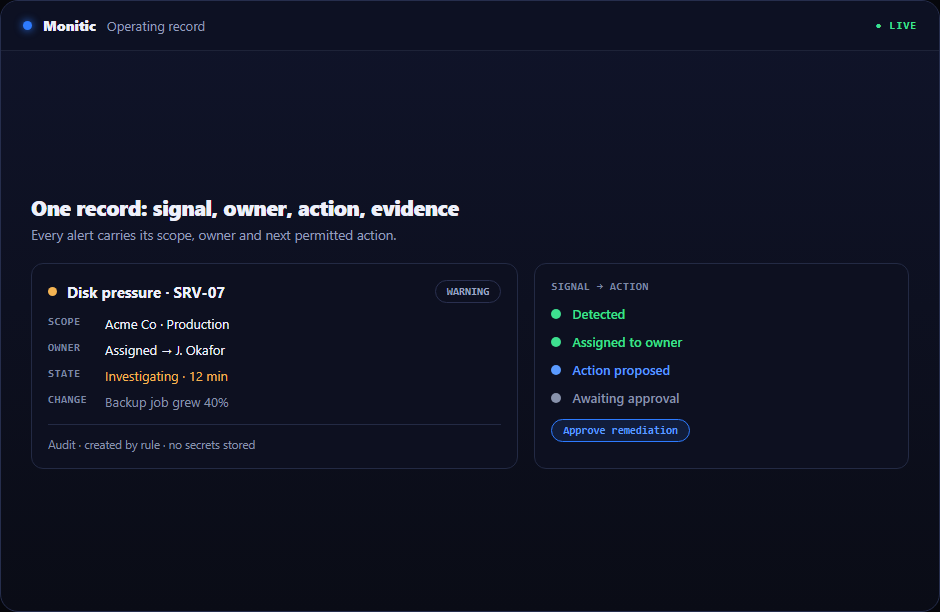
From alert to action
An alert should be the beginning of resolution, not a notification to schedule work. Monitic closes the gap in the same console: process watchers auto-restart critical processes the instant they fail, remote power actions restart or wake machines, and recurring conditions can be handed to the automation engine so the fix runs without a human in the loop. Competing tools alert and wait; Monitic alerts and acts.
Works with
- Device monitoring — the live telemetry every alert rule evaluates against
- The Monitic agent — one lightweight, self-healing collector on every endpoint
- Automation — turn recurring alert conditions into hands-free remediation
Frequently asked questions
How does duration-based hysteresis reduce false alerts?
An alert only fires when a threshold stays breached for a defined duration, and only clears when the metric stays recovered. Momentary spikes and oscillation around the threshold never page anyone, so the alerts that do arrive carry real signal.
Can an alert trigger an automated fix?
Yes. Process watchers restart failed processes automatically, and alert conditions can drive scripts and scheduled tasks through the automation engine — restart a service, clear a disk, power-cycle a machine.
Which metrics support threshold alerting?
CPU, memory, disk, and temperature, with high and low thresholds and per-rule duration windows on every managed Windows, Linux, and macOS endpoint.
Do alerts appear in real time?
Yes. Alert state streams to the console over WebSocket, so dashboards reflect a firing or clearing alert the moment it happens.
See Monitic on your own fleet
Full-featured 14-day trial · no credit card · your real fleet in the console on day one.