One lightweight RMM agent, everywhere you compute
Every Monitic capability — monitoring, patching, remediation, remote sessions — rides on a single lightweight agent for Windows, Linux, and macOS. No per-feature installers, no stack of vendor agents fighting over the same endpoint, no reconciliation project every time you add a capability. One binary to deploy, one to update, one to trust. That simplicity is a cost decision as much as a technical one: fewer agents means fewer failure modes, fewer support tickets, and a shorter path from purchase to production.
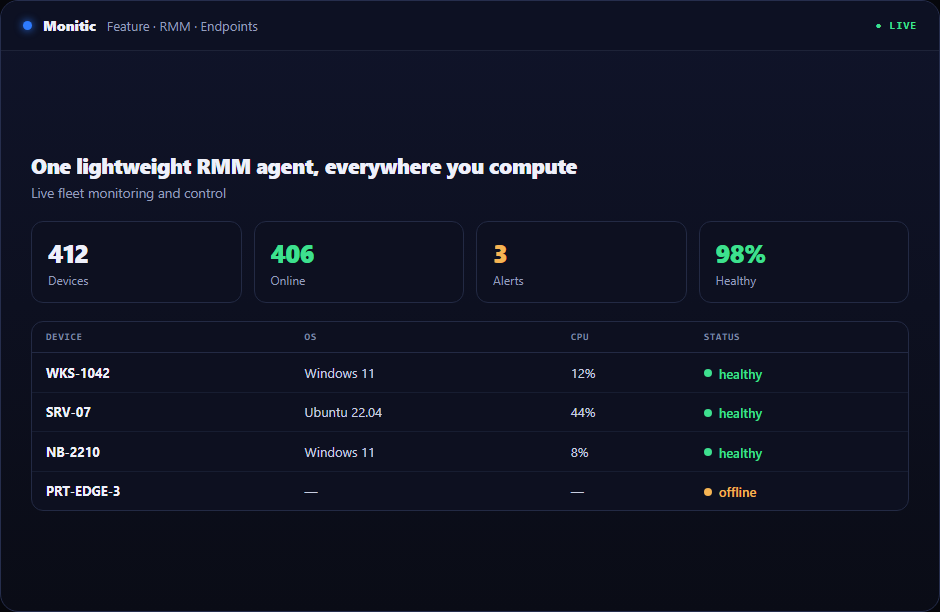
One binary, multiple modes
The Monitic agent is a single executable that runs its capabilities as separate, coordinated modes — core monitoring and task execution, remote desktop sessions, and user-session telemetry each run as their own process, supervised and isolated from one another. A fault in one mode doesn't take down the rest, and your deployment tooling only ever has to distribute and version one artifact. Fleet rollouts stay boring, which is exactly what you want them to be.
Self-healing: the Amon supervisor
Agents fail in the field — every fleet operator knows it. What matters is what happens next. Monitic pairs the agent with a dedicated supervisor, Amon, that watches it continuously and restarts it automatically if it crashes. No dispatch, no remote hands, no endpoint silently dropping out of management for three weeks until someone notices a stale dashboard. The endpoints you think you manage are the endpoints you actually manage.
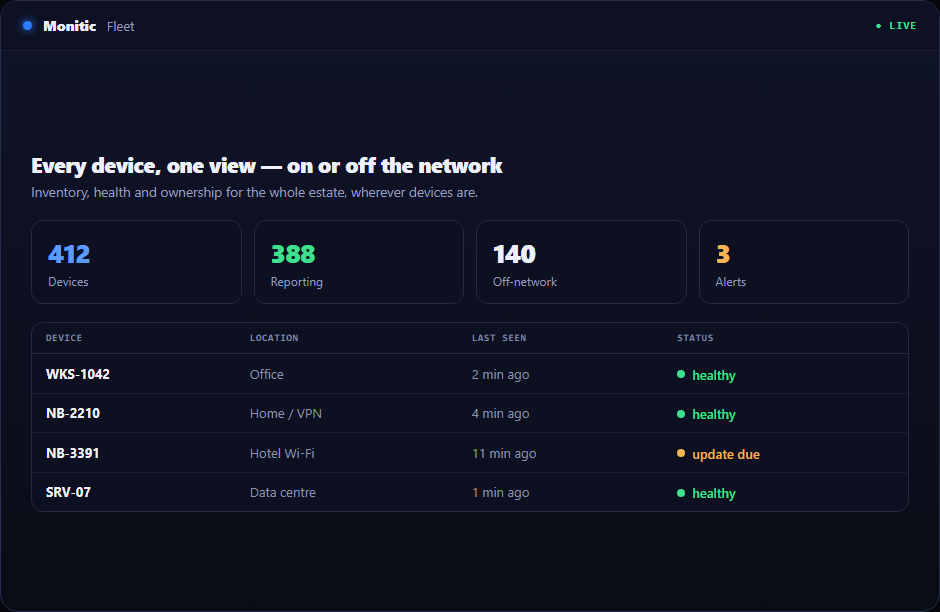
Integrity verified before every launch
Before the agent runs, Amon verifies the binary's integrity with an RSA checksum. A tampered, corrupted, or partially updated binary simply doesn't launch. For security leadership, this answers the uncomfortable question every agent-based platform should be asked: how do you know the code running with system privileges is the code the vendor shipped? With Monitic, it's verified cryptographically at every start.
Small footprint, complete coverage
Lightweight doesn't mean shallow. The agent collects through 50+ data-collection modules — hardware, software, services, performance, event logs — while checksum-based change detection keeps traffic minimal: full inventories aren't re-sent when nothing changed, only deltas are. The result is deep, current visibility that powers device monitoring and alerting without weighing on the machines your users work on.
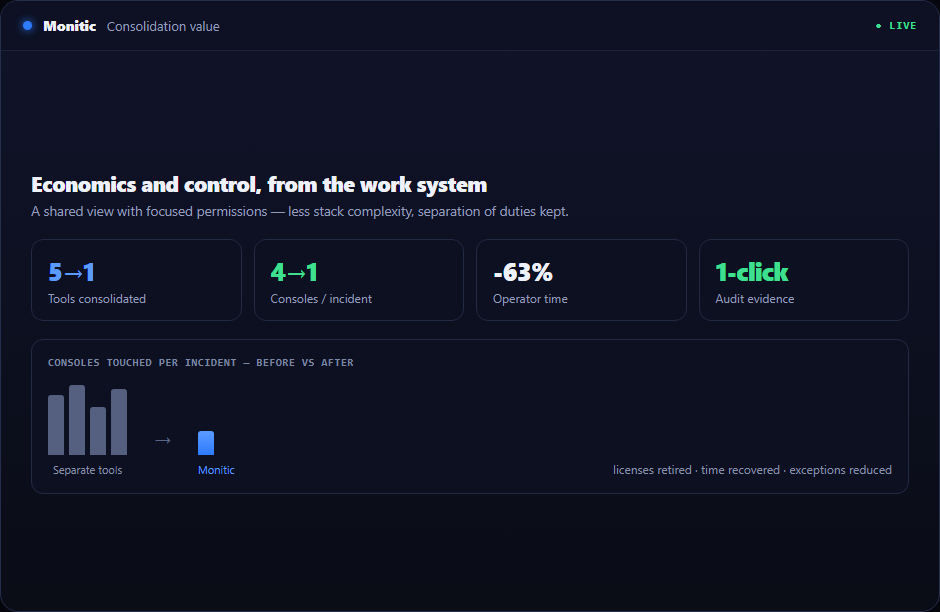
Works with
- Device monitoring — live CPU, memory, disk, and temperature from every agent
- Alerting — duration-based thresholds evaluated on agent telemetry
- Patch management — the same agent that monitors your fleet also patches it
Frequently asked questions
Which operating systems does the agent support?
Windows, Linux, and macOS — servers and workstations — reporting into one console with one data model.
What happens if the agent crashes?
The Amon supervisor detects the failure and restarts the agent automatically, after verifying the binary's integrity with an RSA checksum. Endpoints recover on their own instead of waiting for a technician to notice.
Do I need separate agents for monitoring, patching, and remote access?
No. One binary carries every capability, running its modes as separate supervised processes. You deploy and update a single artifact fleet-wide.
How does Monitic protect the agent from tampering?
The supervisor validates the agent binary with an RSA checksum before every launch. A modified or corrupted binary is refused, so the code holding system privileges is always the code that was shipped.
See Monitic on your own fleet
Full-featured 14-day trial · no credit card · your real fleet in the console on day one.