MSP billing software that lives where the work happens
Every MSP runs two systems of record: the one that tracks what was done, and the one that tracks what it was worth. When those are separate products, month end becomes a reconciliation project — exporting tickets, matching them to contracts, arguing with a sync job about which client owns which work. Monitic puts the finance layer inside the service desk itself: contracts, invoices, ledgers, and tax rates live beside the tickets and requests they bill for. What was delivered and what it costs are two views of the same record, not two databases holding a monthly negotiation.
Contracts tied to clients and delivered work
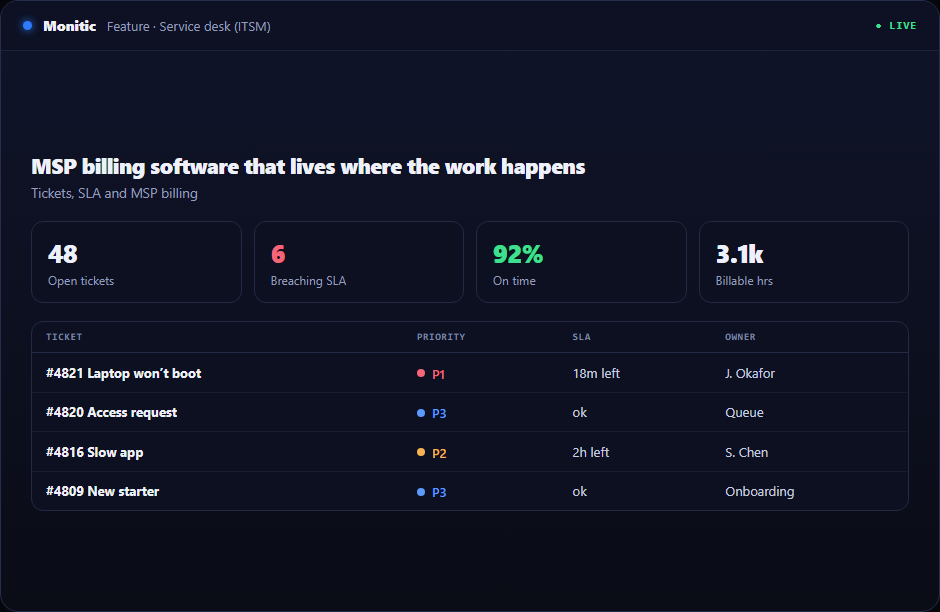
A contract in Monitic is not a filing-cabinet artifact — it is the commercial frame around a client's service delivery. Contracts attach to the clients they govern, and the work your desk delivers for that client accrues against them. Because request fulfillment already distinguishes internal personnel work from billable customer work at intake, the boundary between "cost of running IT" and "revenue from delivering IT" is drawn where it belongs: at the moment the work arrives, not in a spreadsheet three weeks later.
Invoices and ledgers from the same record
When the operational record and the commercial record are the same platform, invoicing stops being an export-and-assemble exercise. Monitic maintains invoices and ledgers per client, built on the delivered work the desk already tracks — so the question "what do we bill this month" has a standing answer instead of a recurring investigation. Tax rates are handled in the platform as well, applied to the commercial documents rather than bolted on in a separate accounting step. The result is an MSP finance layer that requires no PSA purchase, no connector subscription, and no integration that silently drops records the week you need them most.
The desk and the business, one platform
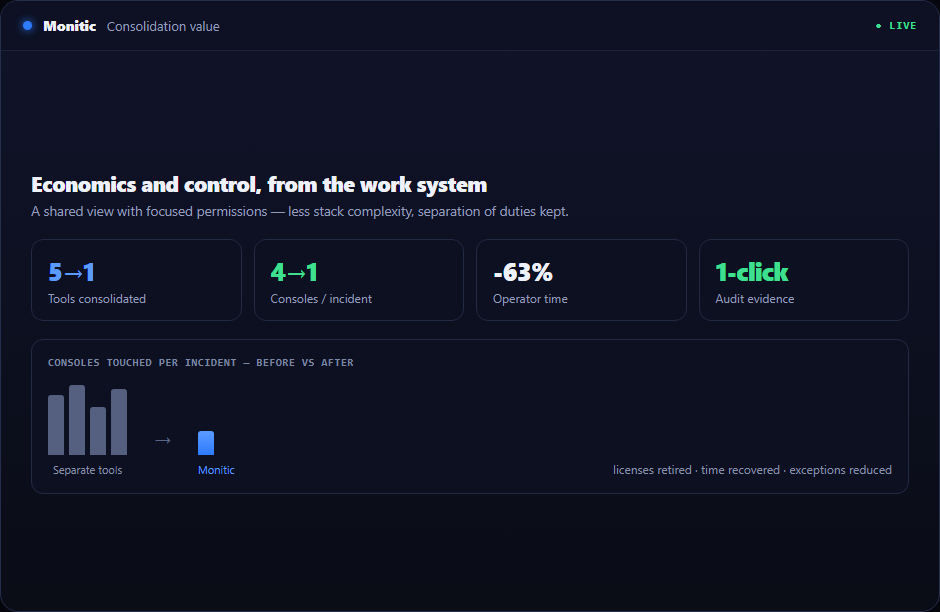
MSP economics live or die on the gap between service delivered and service billed. Keeping billing inside the desk closes that gap structurally: tickets managed in ticketing and commitments tracked in SLA management sit one click from the contract they serve. And because Monitic prices per endpoint with no per-technician fees, adding staff to grow a client does not inflate your tooling cost. For the full multi-tenant picture — client separation, technician scoping, and the operating model built for service providers — see Monitic for MSPs.
Works with
- Request fulfillment — billable customer work identified at intake.
- Ticketing — the delivered work behind every invoice line.
- SLA management — the commitments your contracts promise, measured continuously.
- Monitic for MSPs — the multi-tenant platform the finance layer is built into.
Frequently asked questions
Do I still need a separate PSA for billing?
For the finance layer covered here — contracts, invoices, ledgers, and tax rates tied to clients and delivered work — no. It ships inside the Monitic service desk, so the operational and commercial records share one platform.
How does Monitic know which work is billable?
The desk is requester-type-aware: work raised by internal personnel is treated as internal, and work delivered to customers is treated as billable. That classification happens at intake and carries through to the commercial record.
Does Monitic handle tax rates?
Yes. Tax rates are managed in the platform and applied to invoices, so commercial documents are produced with tax handled rather than corrected afterward.
What does this cost for a growing MSP team?
Per-endpoint plans, and there are no per-technician fees — hiring more engineers to serve a client does not raise your platform bill. See pricing.
See Monitic on your own fleet
Full-featured 14-day trial · no credit card · your real fleet in the console on day one.