Third-party patch management, unified with your OS updates
Operating system patching is table stakes; the applications running on top of it are where fleets quietly fall behind. Browsers, runtimes, and productivity tools update on their own schedules, outside Windows Update's reach — and every version left behind is attack surface nobody is watching. Monitic brings third-party patch management into the same engine that handles OS updates: same agent, same scheduling, same live tracking, same report. One patching program instead of two.
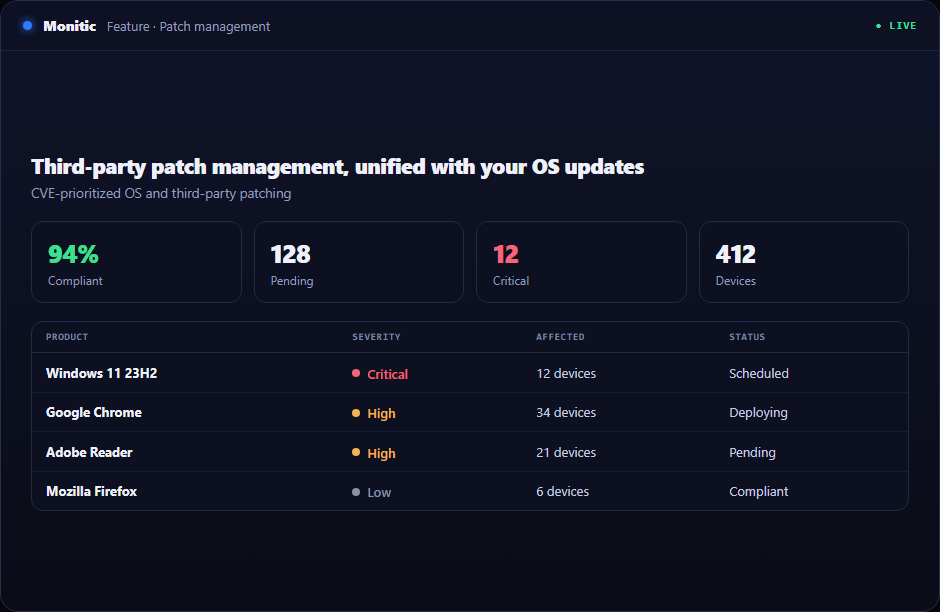
Close the gap Windows Update leaves
Third-party applications are discovered the same way everything else in Monitic is: through the agent's software inventory, kept current with checksum-based change detection. Whatever is actually installed across the fleet — not what a procurement list says should be installed — is what gets evaluated for updates. Shadow installs and long-forgotten utilities show up in the same queue as your sanctioned software, because attackers don't distinguish between them either.
CVE-matched prioritization for application patches
Monitic syncs the CVE database from the NVD and matches it against the installed software inventory on every endpoint. When a third-party application on your fleet carries a known vulnerability, it surfaces at the top of the patch queue — with the affected endpoints identified. Your team patches by measured exposure instead of guesswork, and the vulnerability management module carries the same data through scanning and remediation workflows.
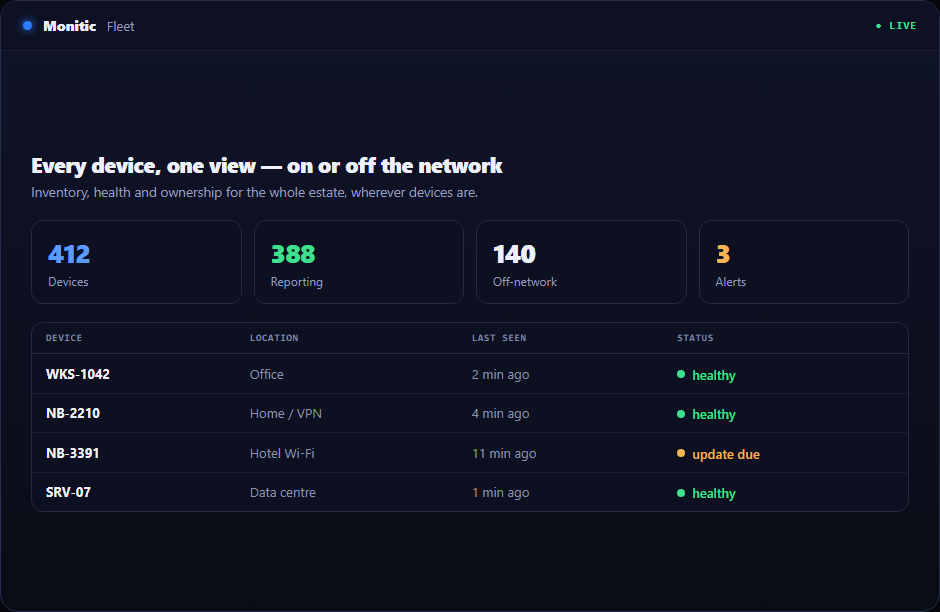
One engine for every patch
Third-party updates deploy exactly like OS updates: as agent tasks with live progress tracking, scheduled and automated through the automation engine. They also coexist cleanly with your Windows infrastructure — Monitic's WSUS integration keeps Windows updates flowing through the channel you already trust, while third-party patching covers what WSUS never could. The result is a single patch calendar, a single deployment mechanism, and a single fleet-wide status report covering both, ready for compliance evidence when the audit comes.
For the CFO, the consolidation math is direct: a standalone third-party patching product is one more license, one more agent, and one more integration to maintain. In Monitic it's simply part of the platform, included in per-endpoint plans.
Works with
- Windows patch management — OS updates and WSUS under the same console
- CVE-driven patching — risk-ranked prioritization across every patch source
- Vulnerability management — find, prioritize, and verify what patching must fix
Frequently asked questions
Which applications does Monitic patch?
Coverage is driven by your software inventory: the agent identifies the third-party applications actually installed across the fleet and evaluates them for available updates, with CVE matching flagging the versions that carry known vulnerabilities.
How are third-party patches prioritized?
Through CVE matching. Monitic syncs vulnerability data from the NVD and cross-references it with installed software, so applications with known exposures on your endpoints rise to the top of the queue.
Does third-party patching conflict with WSUS?
No — they're complementary. WSUS integration handles Windows updates through your existing infrastructure, while third-party patching covers the applications WSUS can't reach. Both report into the same fleet-wide patch status.
Can application patching be automated end to end?
Yes. Scheduled patch runs execute through the automation engine as agent tasks with live progress tracking, and results land in the same compliance-style reporting as OS patching.
See Monitic on your own fleet
Full-featured 14-day trial · no credit card · your real fleet in the console on day one.