IT workflow automation that reaches the endpoint
Generic workflow tools move data between SaaS apps; they cannot restart a service on a laptop in another country. Monitic's IT workflow automation is different because the engine and the endpoint agent are one platform: a workflow doesn't end at a notification, it ends at an action on a real machine. Alert fires, workflow runs, script executes, fleet is fixed — while your team is doing something that actually needs a human.
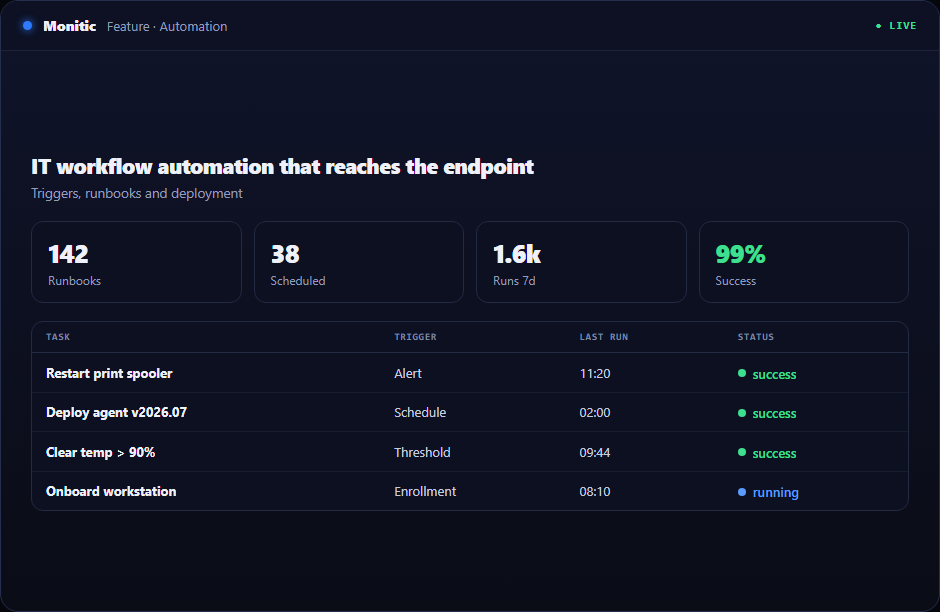
Three triggers: events, webhooks, schedules
Workflows start where your operations start. Platform events trigger reactive automation — an alert crossing a threshold, a device changing state. Inbound webhooks let any external system start a workflow, so your monitoring, security, or business tools can hand work to the fleet directly. Schedules cover the recurring load: nightly cleanups, weekly maintenance, month-end tasks. One engine, three doorways, no bespoke glue code — and no separate scheduler product or integration middleware to license, patch, and secure alongside it.
Build the response from visual blocks
The workflow itself is assembled from visual blocks — conditions, actions, script executions, deployments — arranged on a canvas rather than buried in code. That puts automation in reach of the whole team, not just the one engineer who maintains the scripts, and it makes every workflow reviewable at a glance: what triggers it, what it checks, what it touches. A new hire can read the fleet's operational logic in an afternoon. When a block runs something heavy on the fleet, its progress is tracked step by step in the console like every other Monitic operation.
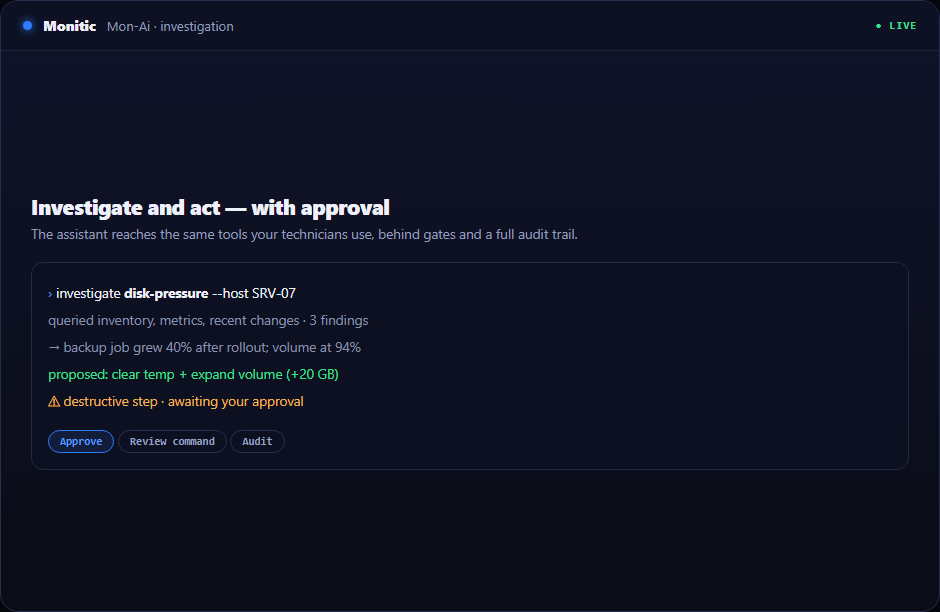
HTTP actions in both directions
Workflows call outbound HTTP endpoints as a native action, so Monitic can update a ticket in another system, post to a chat channel, or push data into anything with an API. Combined with inbound webhook triggers, the engine integrates in both directions without middleware: external systems start Monitic workflows, and Monitic workflows drive external systems. The integration layer you were budgeting for is already in the platform.
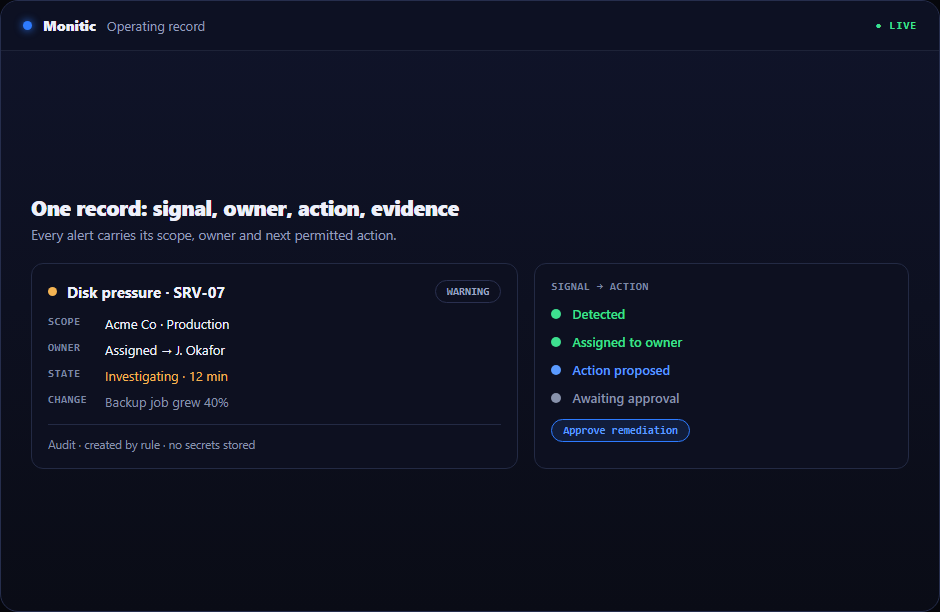
Works with
- Scripting — the PowerShell and Bash library your workflows execute.
- Software deployment — deployments as workflow actions, with live progress.
- Endpoint management — the alerts and device events that trigger workflows.
Frequently asked questions
What is the difference between this and a generic automation tool?
Reach. Generic tools stop at APIs and notifications; Monitic workflows execute on the endpoints themselves — scripts, deployments, service actions — because the automation engine and the agent are one platform.
Can an external system trigger a Monitic workflow?
Yes. Inbound webhooks are a first-class trigger. Any system that can send an HTTP request can start a workflow that acts on the fleet.
Can workflows run on a schedule?
Yes. Schedule triggers handle recurring work alongside event and webhook triggers, so maintenance jobs run without anyone remembering them.
How do we audit what a workflow did?
Heavy operations launched by workflows are tracked with named-step progressions in the console, per device, as they run — so the record of what happened is the same view you used to watch it happen. Nothing runs invisibly.
See Monitic on your own fleet
Full-featured 14-day trial · no credit card · your real fleet in the console on day one.