Hardware inventory software with component-level truth
Most hardware inventory tools stop at make, model, and serial number — enough for a spreadsheet, useless for a decision. Monitic inventories the actual machine: every component, collected automatically by the same agent that monitors and patches the endpoint, updated only when something really changes, with a trail of what changed and when.
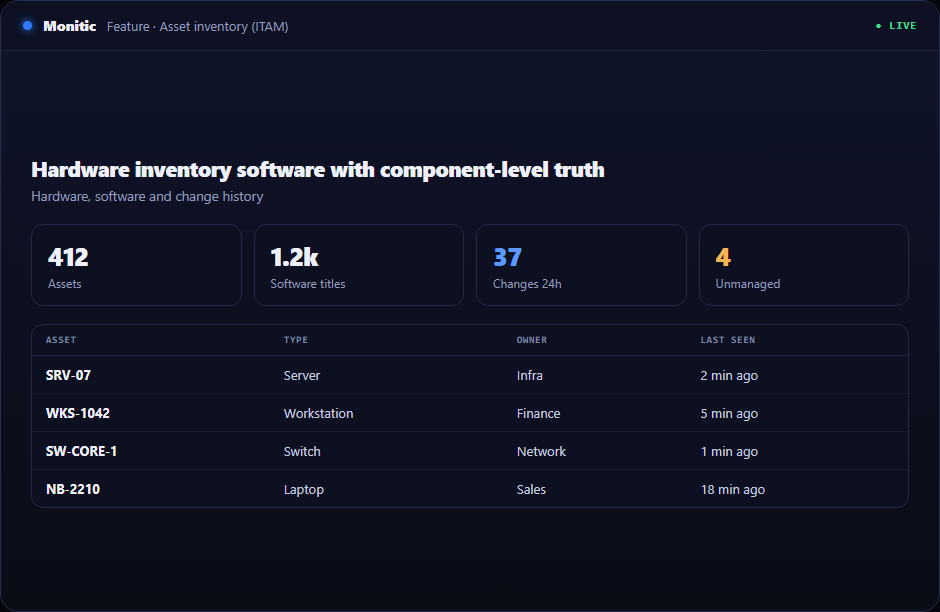
Every component, collected automatically
For each managed endpoint, Monitic records the motherboard, CPU, disks, BIOS, GPU, individual memory modules, network interfaces, and connected monitors. No audit scripts to run, no agents to schedule — the inventory builds itself the moment the agent is deployed and stays current from then on. Component-level depth is what makes the data operational: refresh planning runs on actual CPU generations and memory configurations rather than purchase dates, capacity questions are answered per-machine, and "can this fleet run the new workload" becomes a query instead of a project.
Disk SMART health in the same inventory
Disks are the component most likely to take data with them when they go, so Monitic records SMART health as part of the standard hardware inventory. Degrading drives surface across the whole fleet from the same console you manage it with — no separate disk utility, no per-machine checks. The failure conversation moves from recovery to a scheduled replacement, which is the cheapest form a disk failure can take. Health data feeds the same alerting used across Endpoint Management, so a deteriorating drive is an alert, not a discovery.
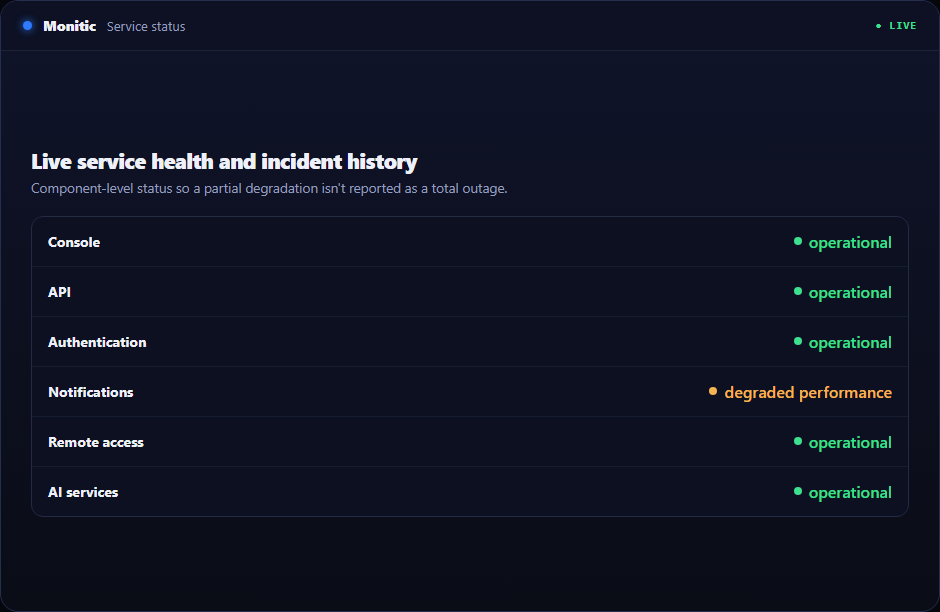
A change trail instead of snapshots
Monitic's collection is checksum-based: the platform re-records hardware only when a component actually changes, and every change becomes a dated entry in the trail. That does two things snapshots cannot. Operationally, the inventory stays clean — no daily duplicates, no noise. Forensically, it answers questions snapshots hide: when the memory in that workstation went from four modules to two, when a disk was swapped, when a GPU appeared in a machine that shipped without one. Hardware drift, loss, and quiet upgrades become visible events rather than discrepancies found at the next audit — if there is a next audit.
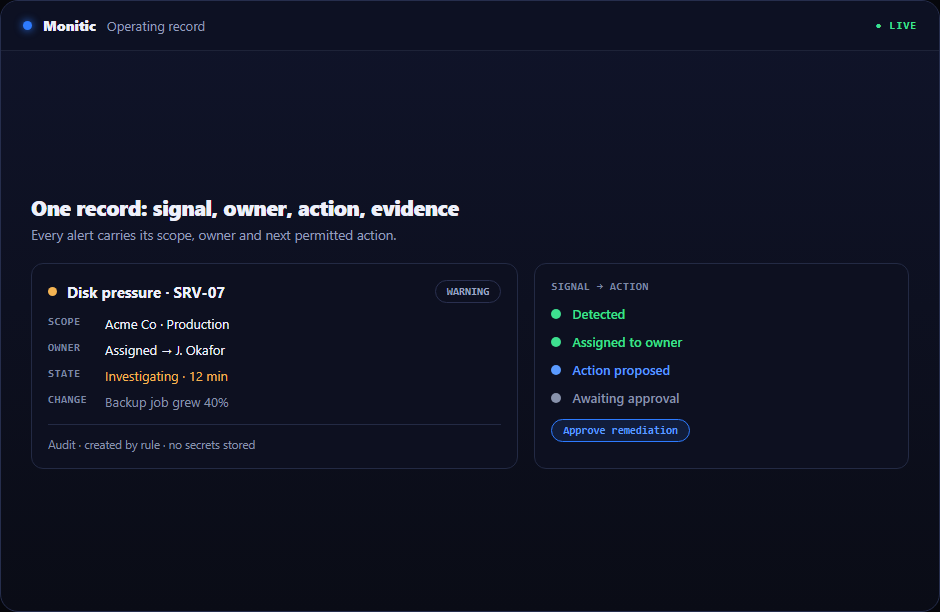
From components to decisions
Because hardware inventory lives inside the platform rather than beside it, the data goes to work: it scopes cleanly per company and unit for multi-tenant estates, flows into 36+ report definitions for lifecycle and audit reporting, and sits next to the software installed on the same machines. Warranty planning, refresh budgeting, and audit preparation stop being data-gathering exercises and start being filters on data you already have.
Works with
- Software Inventory — applications and versions on the same devices, with CVE matching.
- Asset Inventory overview — the full ITAM picture: discovered devices, subscriptions, multi-tenant views.
- Endpoint Management — monitoring and alerting on the same agent, including disk health alerts.
Know exactly what's in every machine
Deploy the agent and get component-level inventory across the fleet — every trial is full-featured for 14 days.
← Back to Asset Inventory
Frequently asked questions
What hardware details does Monitic collect?
Motherboard, CPU, disks including SMART health, BIOS, GPU, individual memory modules, network interfaces, and connected monitors — collected automatically per endpoint by the agent.
How current is the inventory?
The agent detects changes via checksums and updates the record when something actually changes. Between changes the record is already correct, so there is no staleness window tied to a scan schedule.
Can we see when hardware was removed or swapped?
Yes. Every hardware change is a dated entry in the change trail, so removed memory, swapped disks, and other modifications are visible events with timestamps.
Does disk health monitoring require a separate tool?
No. SMART health is part of the standard hardware inventory and feeds the platform's alerting, so failing drives surface in the same console as everything else.
See Monitic on your own fleet
Full-featured 14-day trial · no credit card · your real fleet in the console on day one.