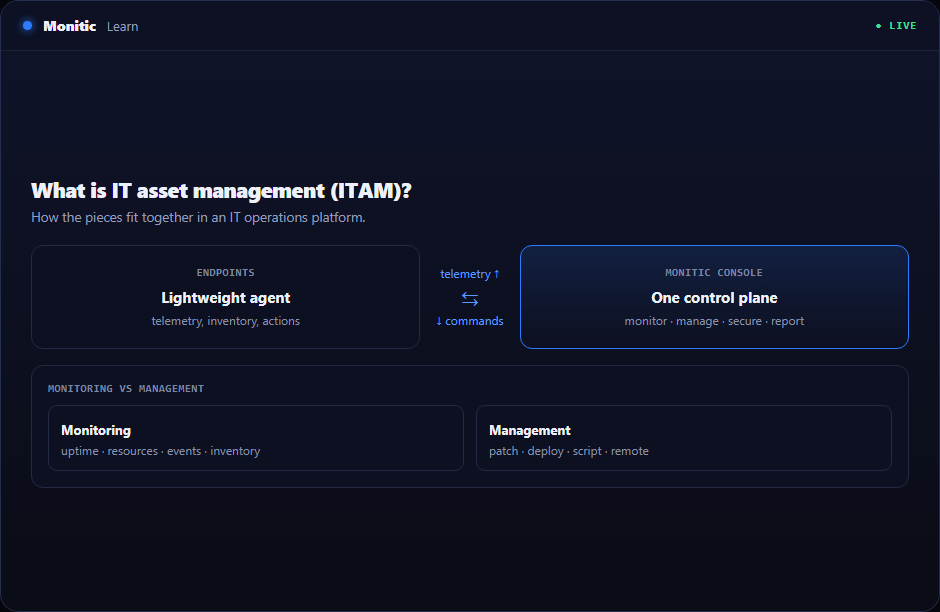
ITAM: definition and scope
An "asset" in ITAM is anything of value the IT organization is accountable for: laptops, servers, monitors, network gear, the software installed on them, the licenses that permit that software, and the cloud subscriptions billed every month. ITAM maintains the authoritative record of all of it — the asset register — and keeps that record accurate as reality changes.
Accuracy is the whole game. An asset register that is 80% correct is arguably worse than none, because people trust it and make decisions on stale data. That is why modern ITAM is built on automated discovery rather than spreadsheets: agents and network scans populate and update the register continuously, and humans only handle exceptions.
How ITAM works
Hardware inventory
An endpoint agent reads the machine's actual configuration — model, serial number, CPU, memory, disks, attached monitors, warranty-relevant identifiers — and reports it automatically. Network discovery fills in agentless devices like printers, switches, and IoT hardware. The result is an inventory built from ground truth, not from what procurement believes was shipped.
Software inventory
The same agent enumerates installed applications and versions on every device. This is the dataset everything else depends on: license reconciliation, vulnerability matching, shadow-IT detection, and standardization efforts ("why do we have four PDF editors?").
Change detection
Static snapshots age immediately; the valuable signal is change. Modern ITAM detects and timestamps deltas — RAM removed from a workstation, an unauthorized application appearing, a disk swapped, a device that stopped reporting. Change history turns the asset register into an audit trail: when a problem appears, "what changed on this machine recently?" is usually the first diagnostic question worth asking.
License and subscription tracking
Software asset management (SAM) — the licensing half of ITAM — reconciles what you bought against what you installed and actually use. It tracks license entitlements, renewal dates, and per-seat subscriptions, and surfaces both directions of mismatch: under-licensing (audit and penalty risk from vendors) and over-licensing (paying for shelfware and unused seats). With SaaS now dominating software spend, subscription tracking — who has a seat, who hasn't logged in for 90 days — is often the fastest source of hard savings ITAM produces.
Benefits of ITAM
- Cost control — recover unused licenses, right-size subscriptions, redeploy idle hardware instead of buying new.
- Audit readiness — answer vendor license audits and compliance requests with evidence instead of panic.
- Faster support — technicians see the device's full configuration and history the moment a ticket arrives.
- Lifecycle planning — age and warranty data drive refresh budgets rather than surprise failures.
- Security foundation — an accurate inventory is the prerequisite for nearly every security control (see below).
ITAM as the foundation for security
Security frameworks consistently place asset inventory as the first control, for a simple reason: you cannot protect what you don't know exists. ITAM feeds security in concrete ways:
- CVE matching — the software inventory is matched against vulnerability databases, so "are we exposed to this CVE?" becomes a query, not a project. This is what makes risk-based patch management possible.
- Unauthorized software and rogue devices — change detection surfaces what appeared on the network or the endpoint without approval.
- Incident response context — when a machine is compromised, its inventory and change history tell responders what was on it and what the blast radius might be.
- Patch coverage gaps — devices missing from the inventory are, by definition, unpatched and unmonitored.
ITAM feeding finance
The same register serves the CFO: asset depreciation schedules, per-department cost allocation, warranty and lease deadlines, and a defensible answer to "what does IT actually own and what is it worth?" When ITAM and procurement share data, refresh planning becomes proactive — replacing hardware on schedule and budget rather than after failures — and software renewals get negotiated with real usage numbers instead of vendor-supplied ones.
How to choose an ITAM solution (best practices)
- Agent-based automatic discovery — the register must populate and update itself; manual entry guarantees decay. The same agent used for RMM can typically supply richer, real-time inventory than a standalone scanner.
- Change detection, not just snapshots — verify the tool records and alerts on hardware/software deltas with timestamps.
- Software and subscription coverage — installed applications and SaaS seats, with usage signals for reclamation.
- Integration with the service desk — asset records should appear inside tickets automatically; an ITAM silo loses half its value. (See what ITSM is for why device context transforms support.)
- Reporting and export — audit-ready license positions, age/warranty reports, and finance-friendly exports.
- Coverage of agentless assets — network discovery for printers, network gear, and unmanaged devices, so the register reflects the whole environment.
Best practice on process: assign ownership (every asset has a responsible person or team), reconcile procurement against discovery monthly, and treat any device found on the network but missing from the register as an incident, not a clerical note.
See how Monitic does IT asset management → Monitic Asset Inventory
Frequently asked questions
What is the difference between ITAM and a CMDB?
ITAM tracks assets as owned objects with cost, ownership, and lifecycle. A CMDB (configuration management database) models configuration items and their relationships — which services depend on which servers. They overlap heavily and share discovery data; ITAM is finance- and ownership-oriented, a CMDB is service-dependency-oriented.
What is the difference between ITAM and SAM?
SAM (software asset management) is the subset of ITAM focused on software: licenses, entitlements, installations, and subscriptions. Hardware asset management is the other half. Modern platforms handle both from the same discovery data.
How does ITAM improve security?
By making the inventory trustworthy. CVE matching, patch coverage, unauthorized-software detection, and incident response all depend on knowing exactly what hardware and software exist — which is why security frameworks list asset inventory as the foundational control.
How often should the asset inventory be updated?
Continuously. Agent-based discovery reports changes in near real time; periodic manual audits then verify the edges (agentless devices, storage rooms, disposals). If your inventory has a "last updated" date measured in months, it is a historical document, not an operational tool.