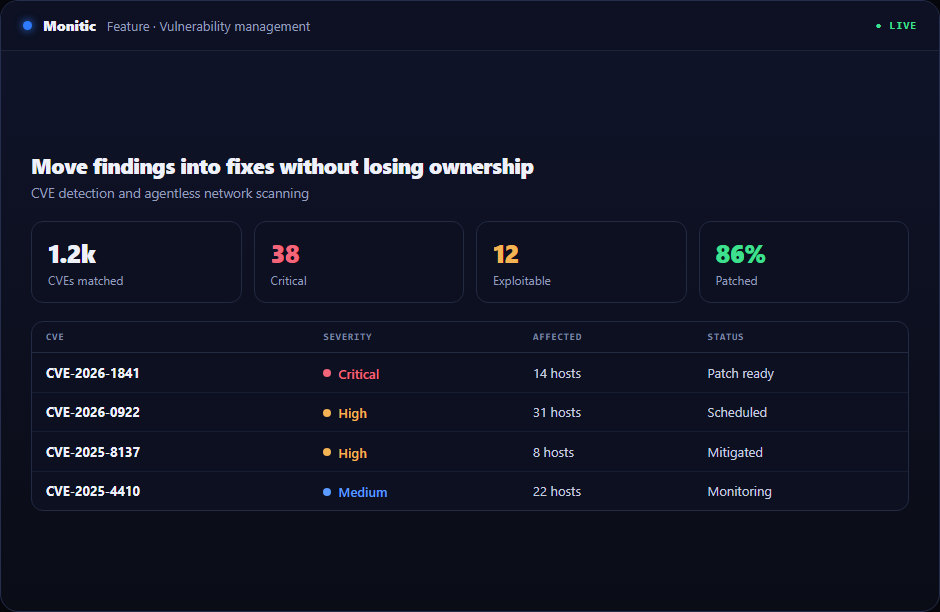
Move findings into fixes without losing ownership
The failure point in vulnerability management is rarely detection. It is the handoff from scanner to endpoint team, the unclear owner, and the absence of a verified close.
Buying a narrow tool to handle vulnerability remediation workflows solves one screen and creates several handoffs. Monitic takes a platform approach: the resource is already tenant-scoped, the operator is already authorized, and the result can feed the same automation and reporting model used elsewhere.
Why this workflow matters
Scale exposes informal process. The technician who remembers every hostname can support fifty devices; the organization managing thousands needs repeatable scope, permissions, and verification. Vulnerability Remediation Workflows becomes valuable when the workflow survives growth and staff change.
Monitic does not flatten every team into one role. It provides common records while preserving company restrictions and separation of duties. Vulnerability Remediation Workflows becomes visible to the people who need context and actionable only to those authorized to change it.
What vulnerability remediation workflows looks like in Monitic
Route findings into patch, script, ticket, or investigation workflows. The important exception remains visible alongside enough surrounding context to judge impact, urgency, and the safest next step.
Preserve affected-device and CVE context through every handoff. Related inventory, service, security, and ticket evidence stays one navigation step away, reducing the chance that a technically correct action ignores business context.
Track remediation outcome instead of treating export as completion. Tenant ownership prevents cross-company ambiguity while RBAC and addon policy keep delegation aligned with the service being delivered.
Evaluation checkpoints for vulnerability remediation workflows
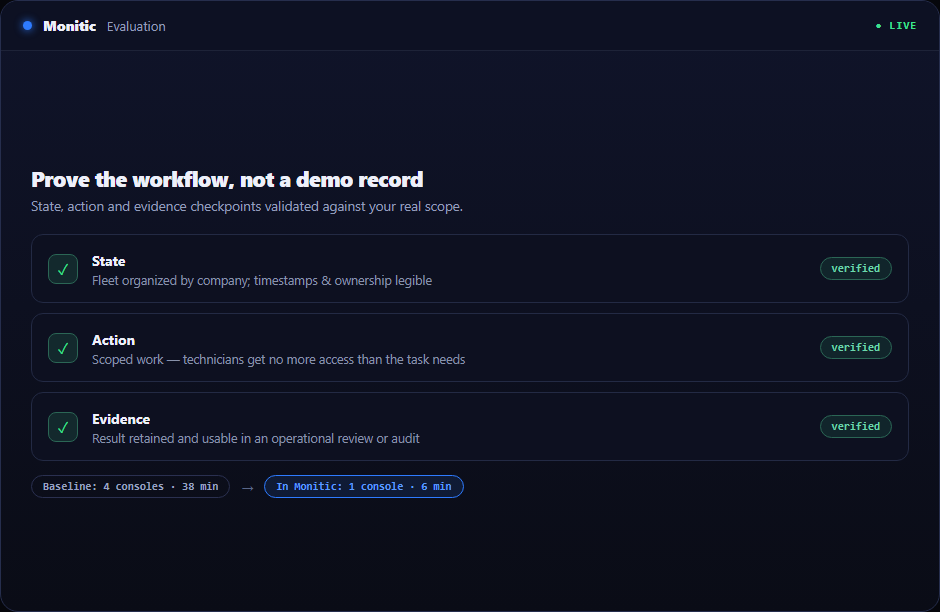
A useful evaluation should prove the workflow against real scope rather than a polished demo record. Use the following checkpoints when validating vulnerability remediation workflow:
- State: Verify that the platform can route findings into patch, script, ticket, or investigation workflows and that timestamps, company ownership, and exceptions are understandable to an operator who did not configure the feature.
- Action: Confirm that authorized technicians can preserve affected-device and CVE context through every handoff without receiving broader access than the task requires.
- Evidence: Check that Monitic can track remediation outcome instead of treating export as completion and that the result is useful in an operational review, customer conversation, or audit.
Record the baseline time, number of consoles touched, and evidence available before Monitic. Repeat the same scenario in the trial. The comparison should show whether vulnerability remediation workflows reduces handoffs as well as completing the technical task.
From evidence to verified action
- Discover. Surface the relevant state across the permitted estate.
- Prioritize. Combine urgency with company, asset, and service context.
- Resolve. Use the appropriate operational tool or route work to its accountable owner.
- Learn. Preserve outcome and recurrence data so the next decision improves.
Each stage remains on the same tenant-safe record.
Business value beyond the feature
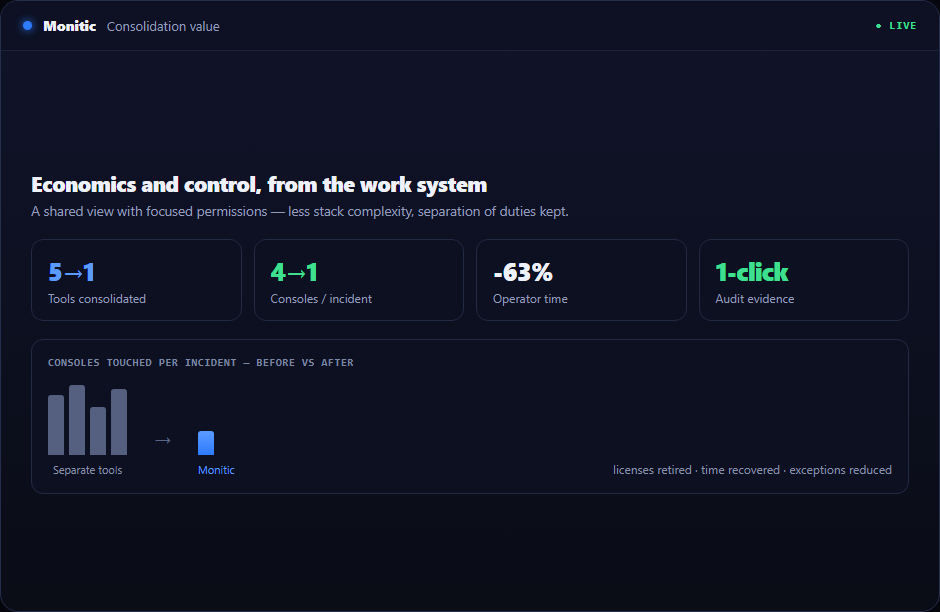
Operational value appears in fewer escalations, shorter diagnosis, safer delegation, and current evidence. Those improvements compound: a reliable record helps the next workflow, report, and AI-assisted investigation rather than disappearing into a closed ticket.
Monitic's modular model lets organizations begin where cost or risk is highest and expand without rebuilding the control plane.
Connected to the rest of the platform
Monitic connects vulnerability remediation workflows to endpoint management, security, infrastructure, and service delivery. The organization can adopt the immediate capability first and add related modules later without migrating the underlying identity and ownership model.
Frequently asked questions
How does vulnerability remediation workflows stay inside the correct customer boundary?
Monitic resolves tenant ownership and company access before returning the resource. Role permissions then determine which operations are available inside that approved scope.
Can read access and change access be separated?
Yes. Teams can delegate visibility more broadly while reserving mutating actions for focused roles, approval paths, or designated operators.
What evidence remains after work is completed?
The platform retains actor, target, time, and outcome context for sensitive or mutating actions. AI-assisted work can also identify the directing person and AI account.
How should we evaluate vulnerability remediation workflow?
Choose a representative workflow, define the expected state and evidence, then test it during the 14-day full-platform trial. Review pricing when the operational fit is proven.
See Monitic on your own fleet
Full-featured 14-day trial · no credit card · your real fleet in the console on day one.