Resolve command-line work without opening a desktop session
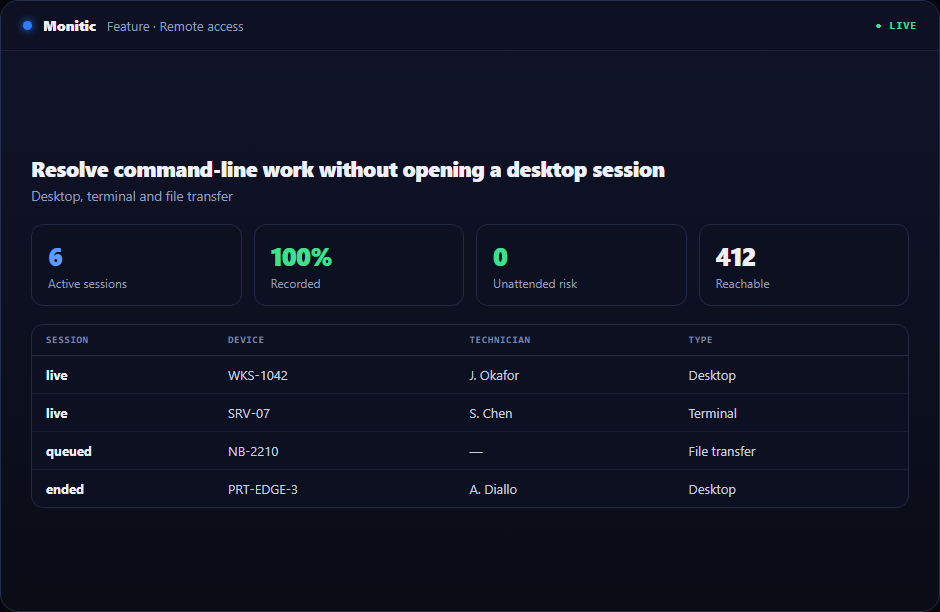
Many support tasks need a shell rather than a screen takeover. A remote terminal lets technicians inspect services, validate configuration, and execute scoped commands while the user continues working.
Remote Terminal belongs in the operating workflow, not in a disconnected utility. Monitic places it beside the asset, company, technician, ticket, automation, and report that give the data meaning. Teams gain the capability without accepting another identity boundary or another console to reconcile.
Why this workflow matters
The hidden cost is the handoff. A technically accurate result can still reach the wrong customer queue, miss a maintenance window, or remain unresolved because no owner was attached. A usable remote terminal workflow must connect signal, responsibility, action, and proof.
A shared control plane makes the sequence explicit: determine scope, inspect live state, select an authorized response, and verify the result. Remote Terminal participates in that sequence with the same ownership and audit conventions as the rest of Monitic.
What remote terminal looks like in Monitic
Open permission-controlled terminal sessions against managed endpoints. History and current condition sit together, helping technicians distinguish a transient event from persistent drift and choose proportionate action.
Use PowerShell or the native shell appropriate to the device. Where a second team must participate, the handoff carries the affected resource, evidence, and requested outcome rather than a vague summary.
Associate session ownership and operational actions with the audit trail. Governance follows the workflow from selection through verification, rather than appearing as a separate compliance task after the change.
Evaluation checkpoints for remote terminal
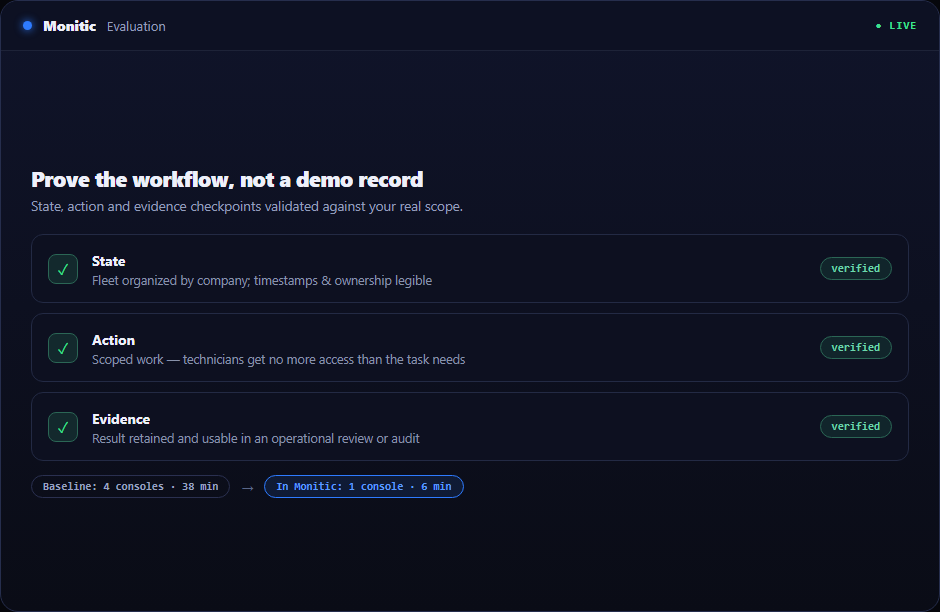
A useful evaluation should prove the workflow against real scope rather than a polished demo record. Use the following checkpoints when validating remote command line for IT support:
- State: Verify that the platform can open permission-controlled terminal sessions against managed endpoints and that timestamps, company ownership, and exceptions are understandable to an operator who did not configure the feature.
- Action: Confirm that authorized technicians can use PowerShell or the native shell appropriate to the device without receiving broader access than the task requires.
- Evidence: Check that Monitic can associate session ownership and operational actions with the audit trail and that the result is useful in an operational review, customer conversation, or audit.
Record the baseline time, number of consoles touched, and evidence available before Monitic. Repeat the same scenario in the trial. The comparison should show whether remote terminal reduces handoffs as well as completing the technical task.
From evidence to verified action
- Frame the question. Identify the company, service impact, and resource involved in remote terminal.
- Validate the evidence. Compare live state with history, inventory, and related alerts or requests.
- Select a controlled path. Assign, approve, automate, or execute using the narrowest suitable permission.
- Confirm the outcome. Retain progress, result, and any exception for the next review.
The discipline is simple: no action without scope, no closure without verification.
Business value beyond the feature
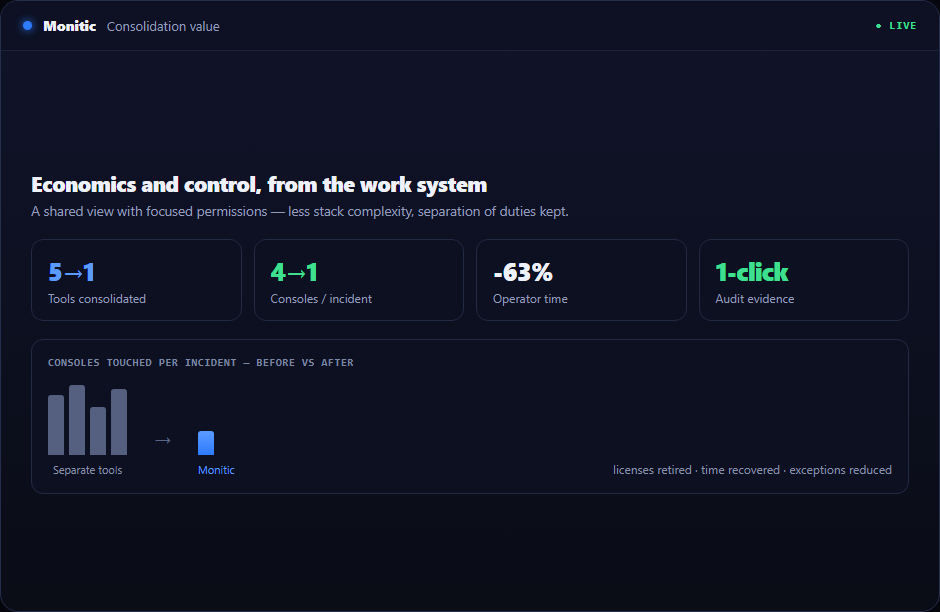
The commercial case for remote terminal includes the human cost around the license: connector upkeep, repeated training, duplicate agents, renewal administration, and minutes lost to every context switch. Consolidation returns that capacity to service delivery.
Because Monitic reuses identity, asset, ticket, automation, and reporting foundations, each adopted capability adds less implementation work than another point product.
Connected to the rest of the platform
The shared data model lets remote terminal contribute to fleet dashboards, tickets, scheduled reports, and AI-assisted diagnosis. Teams avoid building custom glue merely to carry a company ID and asset name from detection to resolution.
Frequently asked questions
What should we configure first?
Begin with scope, ownership, and the smallest useful permission set. Then connect or enroll a representative resource and verify current state before enabling actions or automation.
Can automation participate in remote terminal?
Yes. Stable and repeatable steps can move into scheduled tasks or workflows, while exceptions remain visible for a person to decide.
Where does Mon-Ai fit?
Mon-Ai can gather related context and propose a next step through tools available to the directing user. High-impact execution remains controlled and attributable.
Is the evaluation limited to a demo dataset?
No. The 14-day trial is intended for validation against your own operating model. A guided demo is available when the scenario requires planning or multiple teams.
See Monitic on your own fleet
Full-featured 14-day trial · no credit card · your real fleet in the console on day one.