Firewall monitoring across four vendors, one screen
A firewall is the one device whose bad day becomes everyone's bad day — and in most environments, nobody is actually watching it. The vendor console gets opened when something breaks, which means the early signals (a degraded device, a flapping interface, a DHCP scope running dry) go unseen until they become outages. Monitic is a firewall monitoring tool that watches FortiGate, OPNsense, Sophos, and SonicWall continuously, in the same console that monitors the endpoints and network behind them — so perimeter health is a standing fact, not a post-incident discovery.
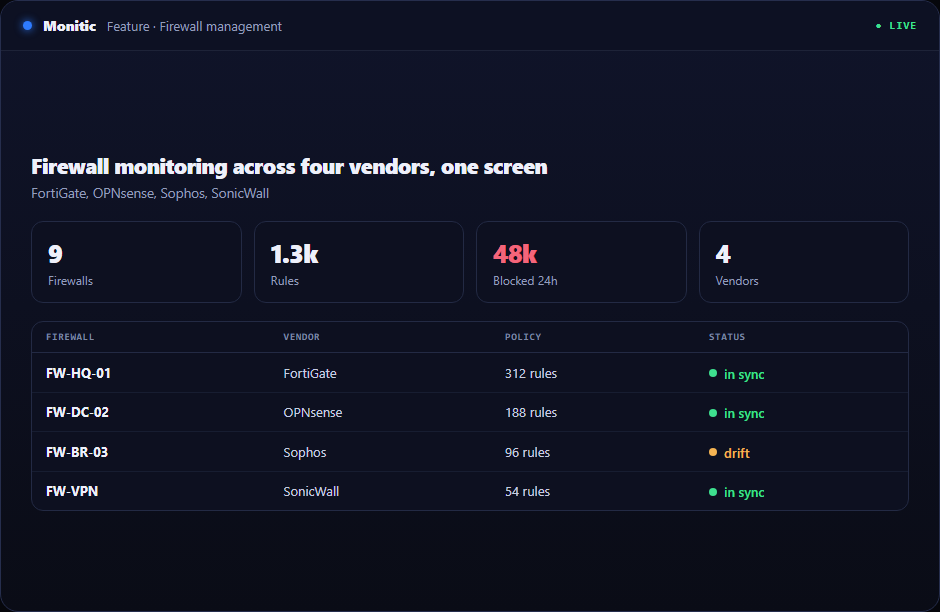
Device health for the devices that matter most
Each integrated firewall reports its health into the console, whatever the vendor. That uniformity is the operational win: an MSP running FortiGate at one client, OPNsense at another, and Sophos at a third watches all of them the same way, with no per-vendor tooling and no per-vendor tribal knowledge on call. A firewall trending toward trouble surfaces alongside everything else the team monitors, in the workflow they already run — not in a console nobody has open.
Because firewall state lives next to endpoint telemetry, correlation is native. When twenty machines behind one gateway lose connectivity at once, the console shows the firewall and the endpoints in the same view — the difference between twenty tickets and one diagnosis.
Interface monitoring: where problems announce themselves
Most firewall incidents are interface incidents first — a WAN link degrading, a VPN interface dropping, a LAN port down. Monitic monitors interfaces across every integrated firewall, so the state of each link is visible per device and per vendor. The failure mode this kills is the silent one: the redundant link that died weeks ago, unnoticed because the primary carried the load, discovered only when the primary followed it.
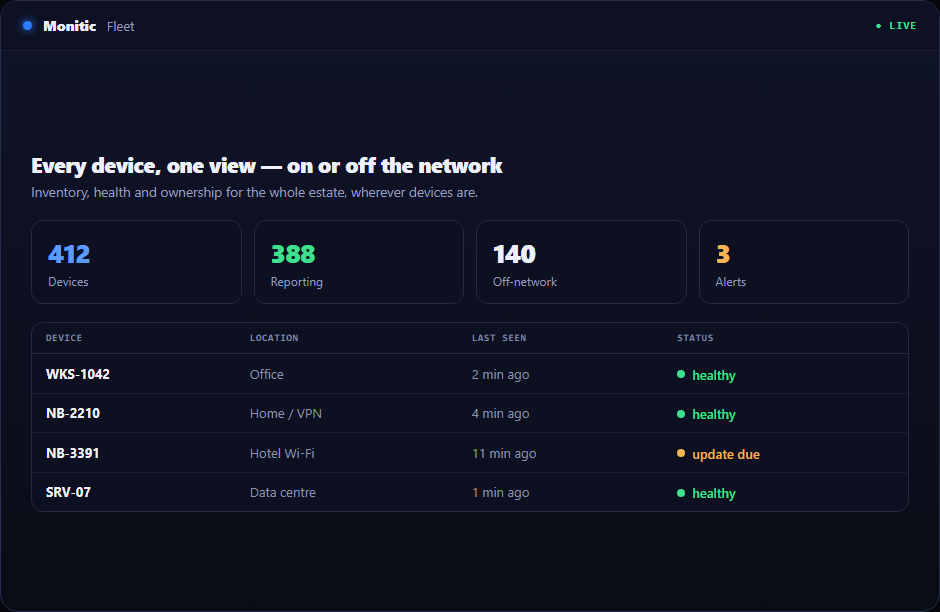
DHCP scope and lease visibility from the firewall
Firewalls frequently serve DHCP for the networks they guard, which makes them the source of truth for "what is on this network." Monitic surfaces DHCP scope and lease data from the firewall integrations: scopes, their utilization, and the leases handed out. An exhausting scope stops being a mystery outage ("new devices can't get online") and becomes a visible condition; an unknown device holding a lease becomes a findable fact during an investigation.
Together — health, interfaces, DHCP — this is the perimeter picture that usually requires logging into every firewall in turn. Here it is ambient, continuous, and multi-vendor. And when the question shifts from "is the firewall healthy" to "why is this specific traffic failing," policy lookup picks up where monitoring leaves off.
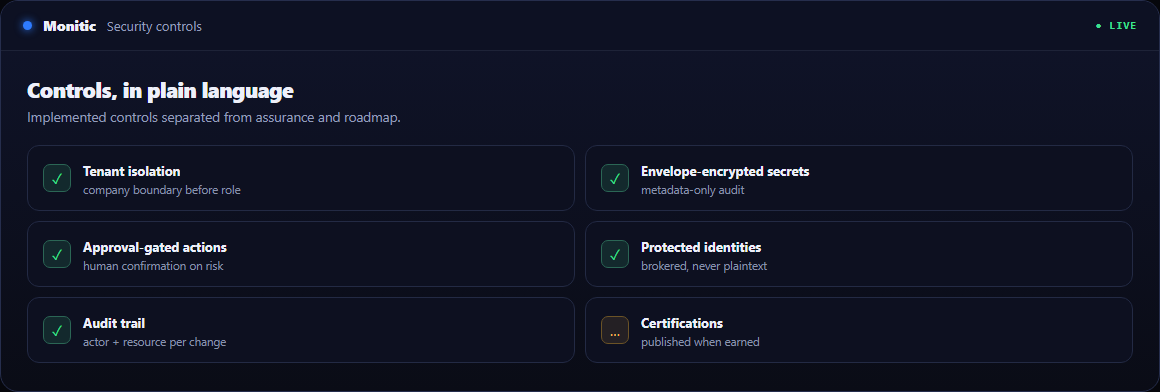
Works with
- Policy management — see the rules the monitored devices enforce
- Policy lookup — the verdict engine for "why is this blocked"
- Network monitoring — SNMP, discovery, and IPAM around the perimeter
Frequently asked questions
Which firewalls can Monitic monitor?
FortiGate, OPNsense, Sophos, and SonicWall. All four report device health and interface status into the same console, alongside DHCP scope and lease data.
Do I need an agent on the firewall?
No. Firewalls are integrated over their management interfaces. The Monitic agent runs on your endpoints; the firewall integrations connect directly.
Can I see DHCP leases without logging into the firewall?
Yes. DHCP scope and lease visibility is part of the integration — scopes, utilization, and leases are readable from the Monitic console.
Is firewall monitoring a separate product?
No — it is part of the Monitic platform, one console with your endpoint, network, and security operations. It's part of per-endpoint platform plans; see pricing.
See Monitic on your own fleet
Full-featured 14-day trial · no credit card · your real fleet in the console on day one.