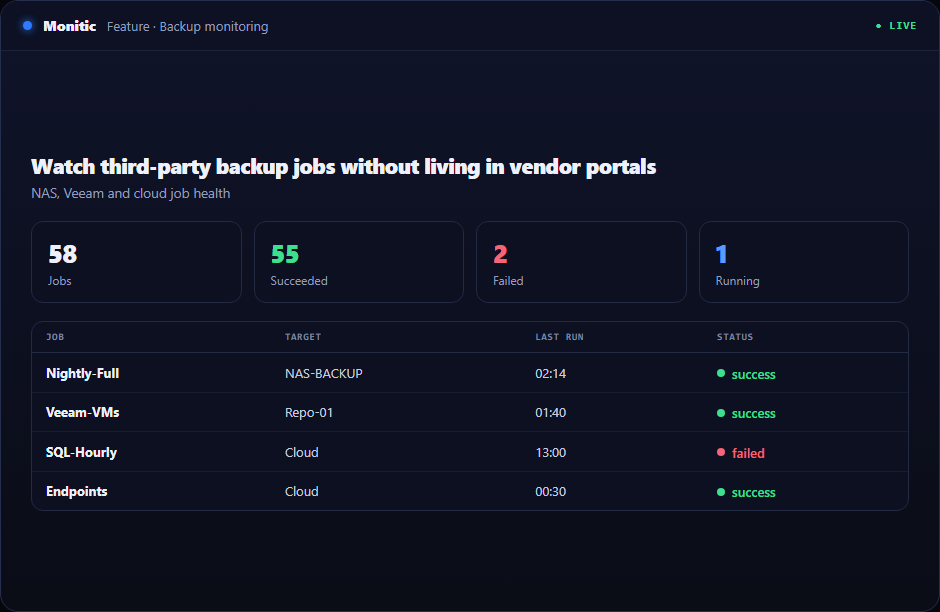
Watch third-party backup jobs without living in vendor portals
Backup estates span vendors and customer accounts. A failed job can sit unnoticed when operators rely on portal-by-portal checks. Monitic polls supported cloud platforms and normalizes the result.
The technical action is only one part of cloud backup monitoring. Teams must also identify the correct company, confirm ownership, work inside a maintenance context, and prove the result. Monitic keeps those decisions in a single governed path.
Why this workflow matters
Leadership sees delay; technicians feel context switching. Both come from the same architecture: separate tools maintain separate versions of the estate. Connecting cloud backup monitoring to the shared asset and service record removes that reconciliation step.
Monitic resolves the company boundary before exposing the resource, then evaluates the operator's focused permissions. Cloud Backup Monitoring can therefore be delegated without handing out unrestricted platform or vendor administration. The same identity follows the action into audit and reporting.
What cloud backup monitoring looks like in Monitic
Monitor Datto BCDR, Acronis Cloud, and Veeam Service Provider Console. Current data is paired with the resource and company behind it; the screen is designed to answer the next operational question rather than merely prove that data was collected.
Normalize success, warning, failure, and stale-job state. A technician can move from observation to the relevant remote tool, workflow, or investigation without re-entering the customer and asset relationship.
Create alerts and deduplicated tickets when a new failure needs action. Human-run, automated, and AI-directed paths converge on the same authorization and evidence model, avoiding a privileged side door for convenience.
Evaluation checkpoints for cloud backup monitoring
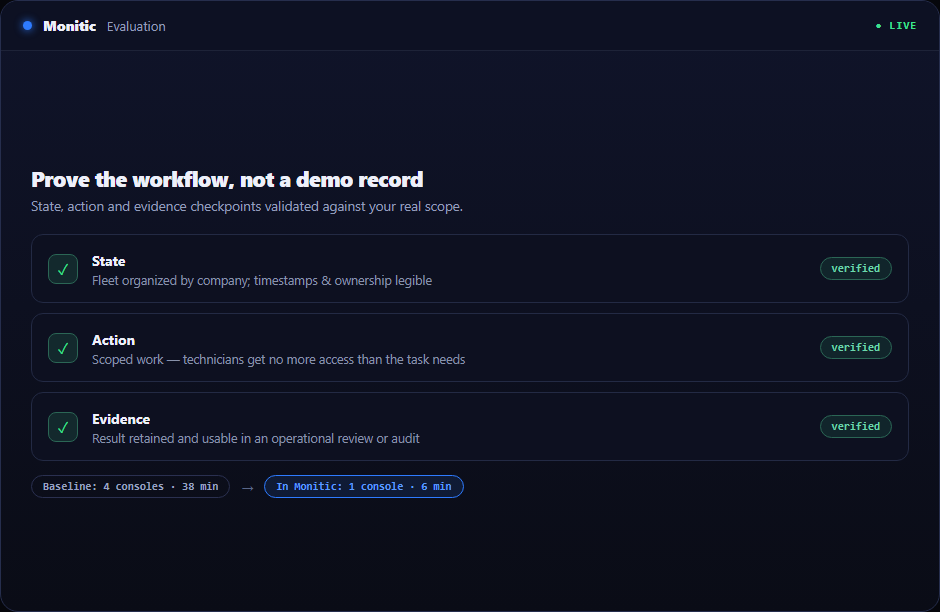
A useful evaluation should prove the workflow against real scope rather than a polished demo record. Use the following checkpoints when validating cloud backup monitoring:
- State: Verify that the platform can monitor Datto BCDR, Acronis Cloud, and Veeam Service Provider Console and that timestamps, company ownership, and exceptions are understandable to an operator who did not configure the feature.
- Action: Confirm that authorized technicians can normalize success, warning, failure, and stale-job state without receiving broader access than the task requires.
- Evidence: Check that Monitic can create alerts and deduplicated tickets when a new failure needs action and that the result is useful in an operational review, customer conversation, or audit.
Record the baseline time, number of consoles touched, and evidence available before Monitic. Repeat the same scenario in the trial. The comparison should show whether cloud backup monitoring reduces handoffs as well as completing the technical task.
From evidence to verified action
- Observe the exception. Separate material conditions from normal variation.
- Attach ownership. Identify the team, technician, or workflow responsible.
- Act with context. Use current evidence and the least disruptive response.
- Make closure durable. Record result, remaining exception, and next review date where needed.
The workflow scales because knowledge becomes evidence rather than folklore.
Business value beyond the feature
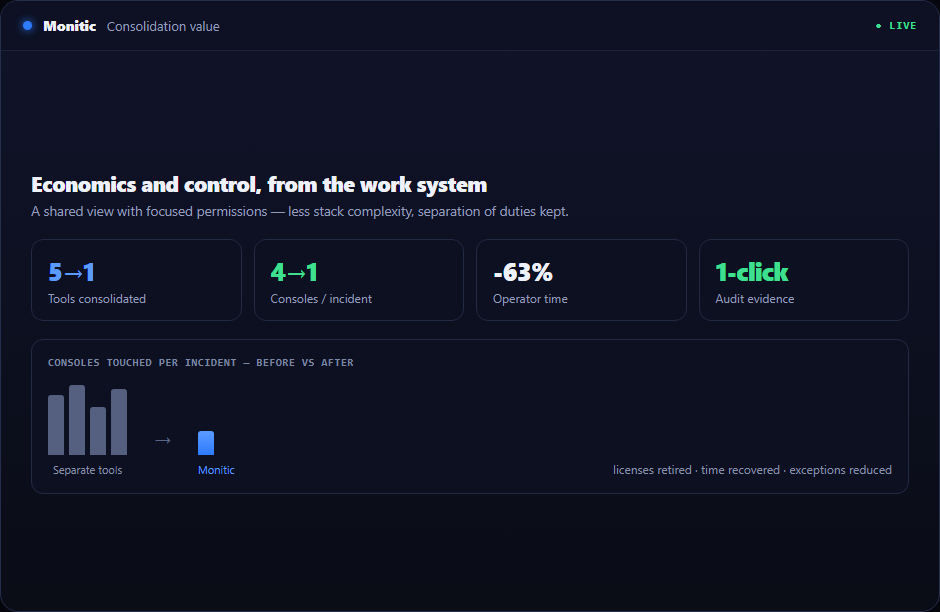
The practical return is operating consistency. A new technician follows the same governed path as an expert; a new customer company inherits the same isolation and reporting model; a new module reuses the established asset and identity foundations.
That consistency is what allows cloud backup monitoring to scale without a matching increase in manual coordination.
Connected to the rest of the platform
The Cloud Backup Monitoring workflow does not end on this page. Service desk can hold ownership, automation can standardize repeatable steps, and reporting can turn current state into recurring evidence. Mon-Ai uses the same scoped context when proposing a next action.
Frequently asked questions
Can we adopt cloud backup monitoring without replacing adjacent systems?
Yes. Monitic can begin as the operating layer around the immediate workflow and expand as integrations and shared context prove useful.
How are sub-users constrained?
A restricted sub-user must first be allowed into the company; RBAC then controls the operations available there. Tenant ownership remains anchored to the root account.
Are AI actions treated differently from human actions?
AI-directed operations use the human director's scope and can carry dual attribution. Manager-approved actions are designed to stop at a confirmation boundary.
Where can we see packaging?
Start with the pricing page and validate the required module during the 14-day trial. A demo can map the capability to a phased consolidation plan.
See Monitic on your own fleet
Full-featured 14-day trial · no credit card · your real fleet in the console on day one.