A worked consolidation scenario for a mid-size MSP
This is a worked scenario — modelled from the tool stacks and pricing patterns we see across mid-size MSPs, not a named customer or audited numbers. Every figure below is illustrative; bring your own invoice and we'll run the same comparison on it.
The starting point
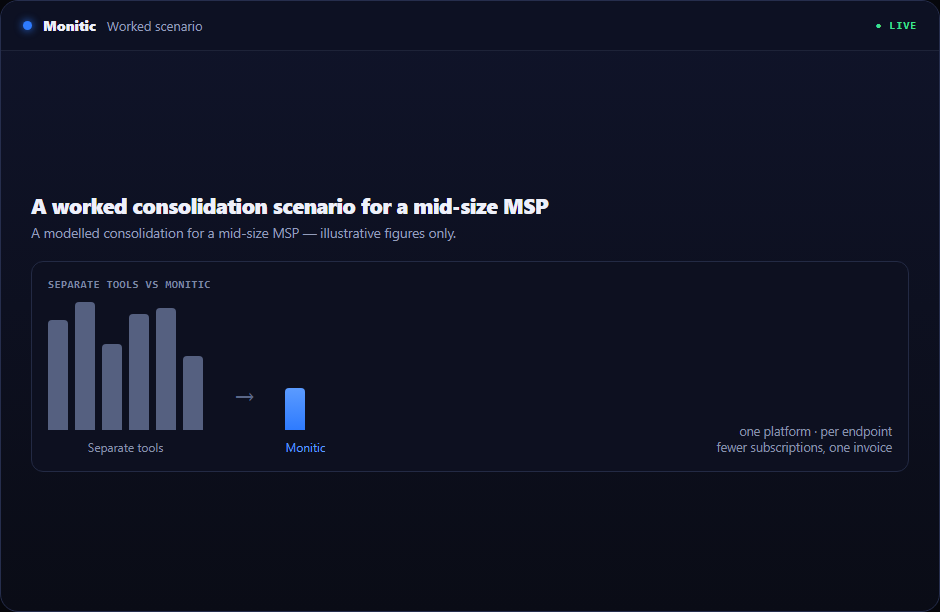
Consider a managed service provider with 12 technicians serving 46 clients and roughly 1,800 endpoints — the classic mid-size MSP profile. Its stack, assembled over a decade, looks like most:
| Tool | Pricing model |
|---|---|
| RMM + patching | Per-endpoint RMM |
| PSA / ticketing | Per-technician PSA |
| Remote access | Per-technician license |
| Vulnerability scanning | Per-asset scanner |
| Password / privileged vault | Per-user vault |
Across 1,800 endpoints and 12 technicians, that's five separate subscriptions on three different pricing models — per endpoint, per technician, and per user — before the hidden line items: the integration middleware that syncs RMM assets into the PSA, the hours spent reconciling them when the sync breaks, and the onboarding tax of five consoles per new hire.
The pain that forced the decision
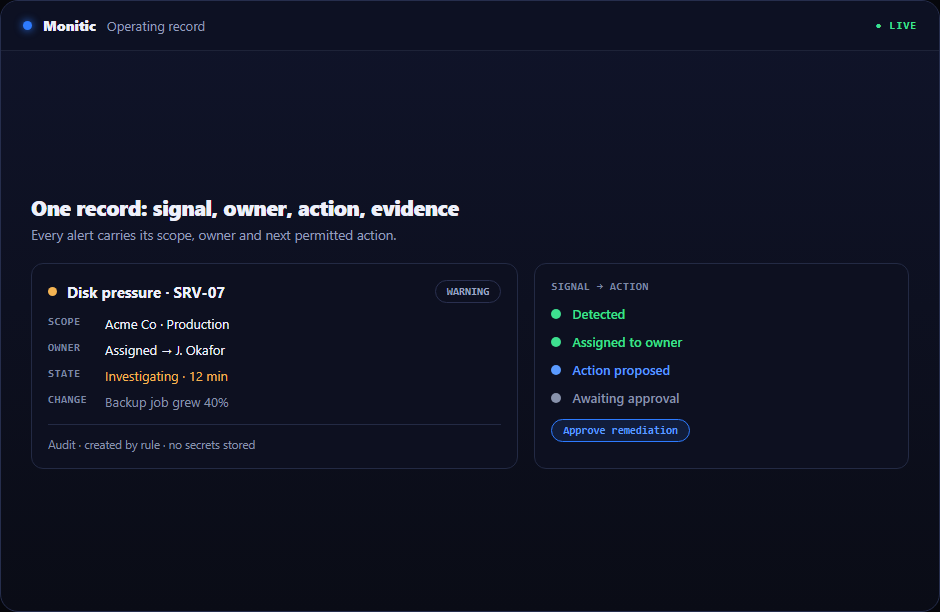
Three things typically push an MSP of this shape to consolidate. First, ticket context: a technician answering a slow-laptop ticket opens the PSA, then the RMM, then the remote tool — three logins to learn what one screen should have said. Second, the security upsell it couldn't make: clients began asking for vulnerability reporting and compliance posture, and quoting a separate scanner per client killed the margin. Third, per-technician pricing: every new hire raised the PSA and remote-access bills before earning a single billable hour.
The consolidation, in three waves
Wave 1 (weeks 1–2): fleet. Deploy the Monitic agent alongside the incumbent RMM — the agent carries monitoring, inventory, remote access, and patching in one binary, so three tools are candidates for retirement at once. Clients are modeled as tenants; technicians get per-client allow-lists.
Wave 2 (weeks 3–6): desk. Tickets move to the Monitic service desk, where device context is native. Email-to-ticket redirects client mailboxes; SLA policies and automation rules are rebuilt once, centrally. The billing layer takes over contracts and invoicing.
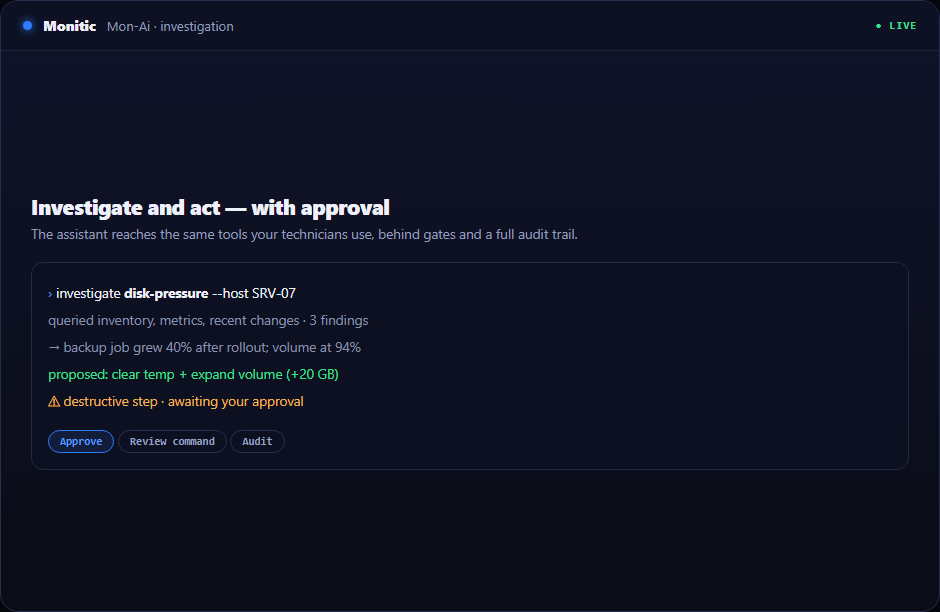
Wave 3 (weeks 6–10): security tier. With CVE detection and compliance posture now included per endpoint, the MSP packages a "Secure" service tier — sold at a premium, delivered at near-zero marginal tooling cost. Monitic AI picks up overnight triage with approval-gated actions.
The after-state economics
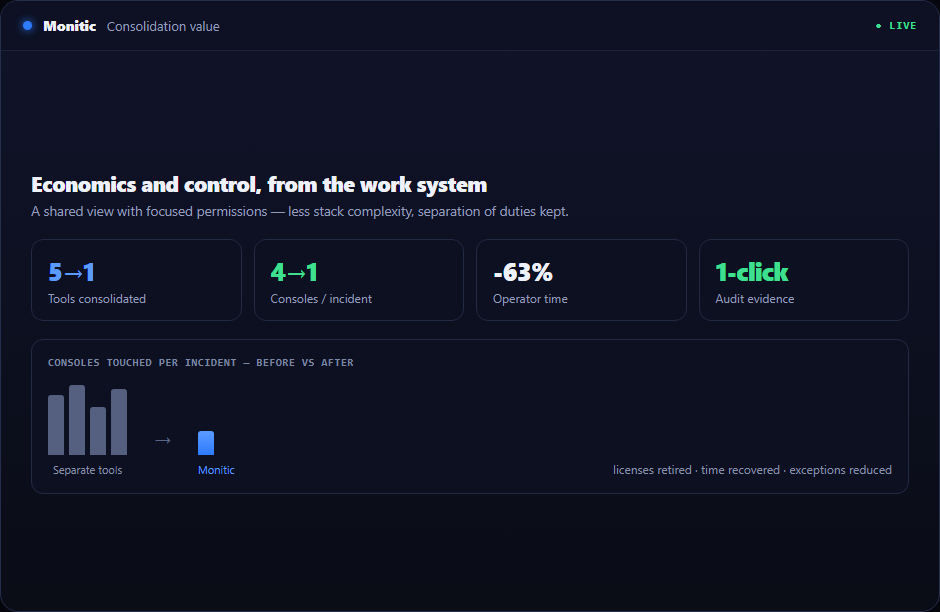
On Monitic Enterprise — the same surface on one per-endpoint plan, with volume discounts that apply at this scale — five subscriptions on three pricing models collapse into a single line item, and the per-technician taxes disappear entirely. Hiring technician #13 now changes the payroll line and nothing else.
The revenue side moves more. The Secure tier — vulnerability posture, compliance reporting, patch SLAs — becomes sellable to all 46 clients at once, because the capability is already in the per-endpoint price. That's the part no discount can match: consolidation didn't just cut cost; it created a product.
Why the fit is structural, not incidental
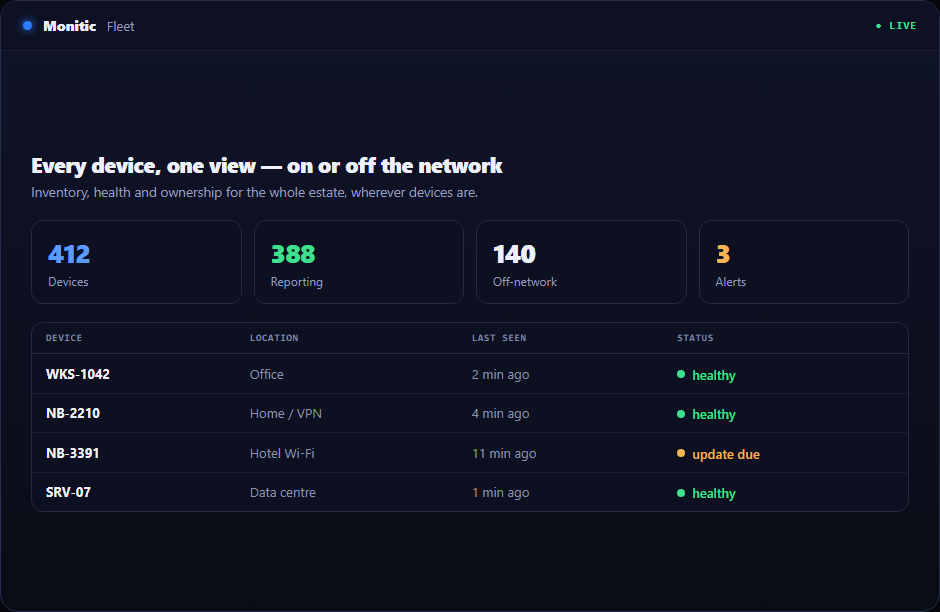
Monitic's tenancy, technician allow-lists, client-scoped reporting, and MSP billing weren't integrations added for a segment — they're the platform's ownership model. An MSP is, architecturally, what Monitic assumes the world looks like: many isolated fleets, few operators, every action needing an audit trail.
Run this math on your own stack
Send us your current tooling invoice and endpoint count; we'll return the same worked comparison for your numbers within one business day.
Start your free 14-day trial · Get a demo · Join the MSP partner program
See Monitic on your own fleet
Full-featured 14-day trial · no credit card · your real fleet in the console on day one.